





The Splashdown
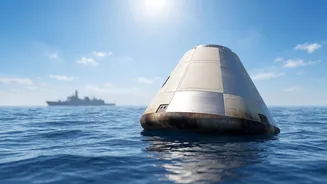
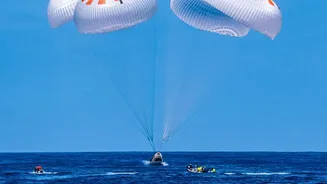
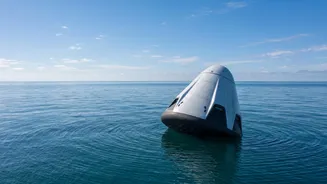
The recovery operation begins the moment the Gaganyaan crew module, after its fiery re-entry into Earth's atmosphere, splashes down into the Bay of Bengal. The target landing zone, typically about 10 kilometres off the coast of Sriharikota, is precisely
calculated beforehand. As the module hits the water, its parachute systems are automatically jettisoned to prevent entanglement. Immediately, specially designed flotation bags inflate, ensuring the capsule remains upright and stable, even in choppy waters. This 'up-righting' system is crucial to keep the module oriented correctly so the crew can be safely rescued.
Pinpointing the Location
Finding a relatively small capsule in the enormous ocean is a significant challenge. To solve this, the crew module is equipped with a suite of tracking technologies. It instantly begins transmitting its GPS coordinates via radio beacons, which are picked up by satellites and recovery aircraft. For visual confirmation from the air, the module releases a bright green fluorescent dye, creating a large, unmissable patch in the water. If the splashdown occurs at night or in low-visibility conditions, high-intensity strobe lights on the capsule activate, providing a flashing beacon for recovery teams to home in on.
The Naval Recovery Team
The entire at-sea recovery operation is a masterclass in collaboration, led by a highly trained team from the Indian Navy in close coordination with ISRO. Naval ships, including specialised vessels, are pre-positioned at a safe distance from the designated splashdown zone. Once the module is located, these ships approach it. The first to make contact are expert naval divers. Their job is to approach the floating capsule, conduct an initial inspection, and attach a recovery buoy and tow lines. These teams undergo extensive training at facilities like the Water Survival Training Facility in Kochi, practising every step of the procedure using mock-up modules that perfectly replicate the real capsule's mass, shape, and centre of gravity.
The Critical Lift
With the module secured, the next step is to get it out of the water. This is arguably the most delicate part of the entire operation. Depending on the recovery vessel, there are a couple of methods. One involves using a large onboard crane to carefully hoist the multi-tonne module from the sea and place it onto the ship's deck. Another, more advanced method involves a 'well deck' ship. This type of vessel has a stern section that can be flooded with water, allowing the crew module to be gently towed directly inside the ship. Once the module is positioned on a secure fixture, the water is drained from the well deck. This method is considered a preferred option as it minimises stress on the module and provides a more stable environment for the crew to emerge.
Back to Shore for Analysis
Once safely aboard the recovery ship, the crew module is secured for its journey back to port, often Chennai. This final leg is just as important, as the module contains invaluable data from its flight. For test flights like the recent abort mission, this data helps engineers evaluate the performance of every system, from the parachutes to the heat shield. In a crewed mission, this would be the point where the astronauts, having been retrieved from the capsule, receive medical checks. The successful and swift recovery of the module is not just about bringing back hardware; it validates the end-to-end procedures that will one day ensure the safe return of India's 'Gaganyatris'.