


Centaurus A: A Galaxy's Second Life
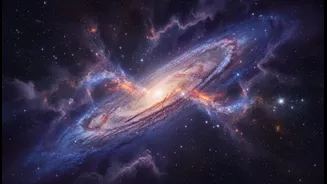
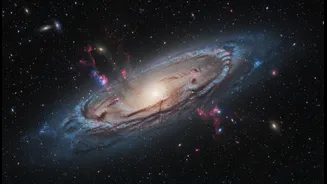
Celebrating its fourth year of operations, the James Webb Space Telescope has delivered an unprecedented view of Centaurus A. Located a relatively close 11 million light-years away, this galaxy is a hotbed of activity, the result of a colossal collision
with another galaxy billions of years ago. While previous telescopes saw only a blur obscured by thick cosmic dust, Webb's powerful infrared vision cuts through the haze. The result is a breathtaking tapestry revealing millions of individual stars, allowing scientists to perform 'galactic archaeology'. By studying these stars, they can piece together a timeline of the galaxy's violent past and its subsequent rebirth, watching how the supermassive black hole at its center shapes the entire system.
The Dust Conundrum
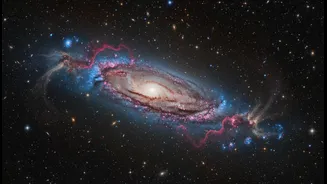
One of the most captivating new views of Centaurus A comes from Webb's Mid-Infrared Instrument (MIRI). This image highlights the galaxy's intricate dust structures in glowing shades of red and orange. Astronomers are particularly intrigued by a strange, parallelogram-shaped band of dust and a peculiar 'S' shaped feature curling near the galactic core. These aren't just random clouds; they are clues to the powerful forces at play. Scientists are now working to understand what created these shapes. Was it the lingering gravitational chaos from the ancient galaxy merger, or is it the influence of the powerful jets of energy blasting from the central black hole? These images don't just provide answers; they generate fascinating new questions.
A Cosmic Starburst
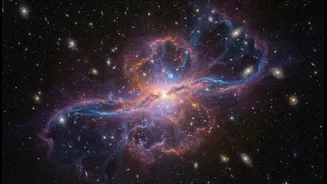
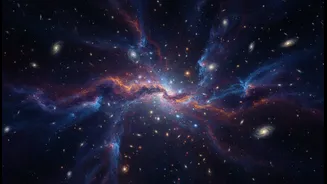
Centaurus A is known as a starburst galaxy, meaning it's forming stars at an exceptionally high rate. The new Webb images make it clear why. What might look like 'noise' or graininess in the picture is actually a dense field of countless individual stars. The images reveal stellar nurseries where new stars are being born from swirling gas and dust, and also show older stars shedding their material back into the galaxy. It’s a complete lifecycle on a galactic scale. This detailed view helps scientists understand how a major event like a galaxy collision can trigger intense periods of star formation, providing the raw materials for a new generation of stars and planetary systems.
Beyond a Single Telescope
While Webb's latest release is groundbreaking, space agencies emphasize that these discoveries build on decades of previous work. The Hubble Space Telescope provided stunning views in visible light but was blocked by dust. The Spitzer Space Telescope could see in infrared but lacked the sharpness to resolve individual stars. Webb combines the best of both worlds—infrared sensitivity and incredible resolution—to tell a more complete story. This collaborative approach, where each new mission expands on the foundations of the last, is crucial. It’s a reminder that our understanding of the universe is an ongoing conversation between different instruments and generations of scientists, all working to piece together the grand cosmic narrative.
Simplifying the Science
Beyond the stunning visuals and scientific data, this release is about making astronomy accessible. NASA and ESA have provided guided tours and detailed explanations that break down what we are seeing. Instead of just presenting a photo of a galaxy, they explain that the grainy texture is actually millions of suns, and the dark bands are not empty space but thick clouds of dust that will one day form new stars. This effort transforms a complex scientific observation into a shared moment of human discovery. It allows anyone to look at an image of Centaurus A and not just see a pretty swirl, but to understand its violent history and dynamic present, bridging the gap between professional astronomers and the public.