




The Planet That Spins Backwards
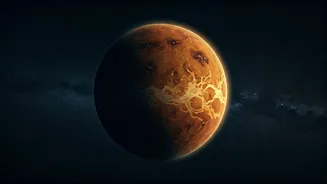
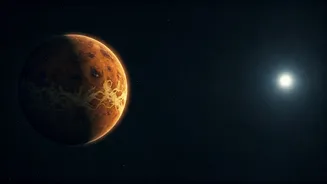
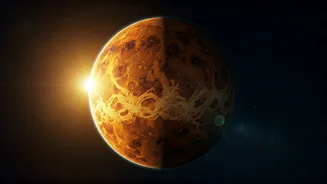
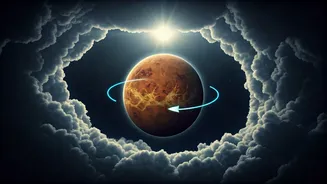
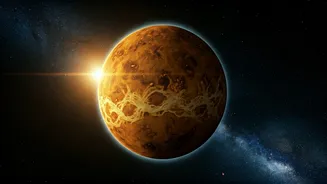
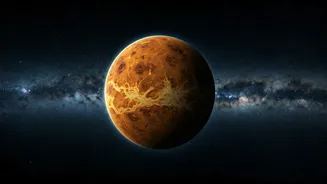
Imagine a world next door that breaks all the rules. Most planets in our solar system, including our own, spin on their axis in a counter-clockwise direction. This is called prograde rotation. Venus, however, spins clockwise. This is known as retrograde
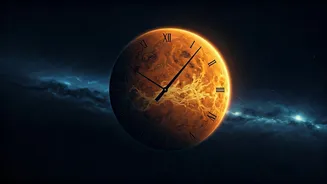
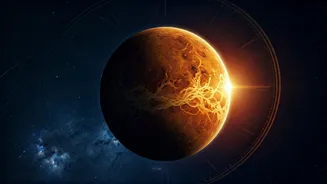
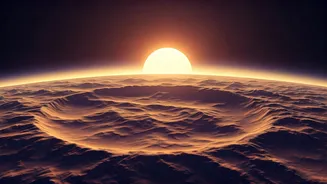
rotation. If you could stand on Venus (which you can't, due to the crushing pressure and searing heat), you would see the Sun rise in the west and set in the east. But the weirdness doesn't stop there. Venus's spin is incredibly slow. It takes about 243 Earth days for Venus to complete one rotation on its axis. Bizarrely, it only takes about 225 Earth days for it to orbit the Sun. This means a day on Venus is longer than its year—a concept that completely baffled early astronomers who were used to the tidy celestial mechanics of Earth and Mars.
A Veil of Mystery
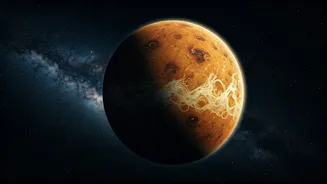
The primary reason this puzzle persisted was that astronomers couldn't actually see the surface of Venus. The planet is perpetually shrouded in a thick, opaque blanket of clouds made mostly of sulfuric acid. These highly reflective clouds are what make Venus shine so brightly in our night sky, but they also form an impenetrable veil.
For centuries, observers using optical telescopes could only map the movements of these upper cloud layers. They had no way of knowing if they were observing the movement of the planet itself or just the weather patterns high in its atmosphere. Without any visible surface landmarks—like craters, mountains, or valleys—to track, determining the planet's actual rotation period and direction was pure guesswork. They were staring at a featureless, brilliant billiard ball.
Early Guesses and Wrong Turns
In the absence of data, theories abounded. Many early scholars assumed Venus was tidally locked to the Sun, meaning one side would permanently face the Sun, just as the same side of our Moon always faces Earth. This would have resulted in a rotation period equal to its orbital period of 225 days. Others, noticing a strange (and ultimately coincidental) pattern, theorised that Venus was tidally locked to Earth, presenting the same face towards us each time the planets were at their closest approach.
These theories were logical deductions based on the limited information available. Tidal locking is a common phenomenon in the cosmos. However, they were built on assumptions rather than hard evidence, and as technology advanced, it became clear that the real answer was far more complex and unexpected.
The Breakthrough Signal
The game changed in the 1960s with the advent of radar astronomy. Scientists at facilities like NASA's Goldstone Observatory and the Arecibo Observatory in Puerto Rico realised they could do what light could not: pierce the clouds. By bouncing powerful radar signals off the surface of Venus and analysing the faint echo that returned to Earth, they could finally measure the planet's physical properties.
The Doppler effect on the returning signals revealed the speed and direction of the surface's movement. The results were shocking. The data confirmed the incredibly slow 243-day rotation period and, most importantly, its retrograde direction. The centuries of speculation were over. The mystery wasn't just in their heads; Venus was genuinely, fundamentally bizarre.
What Drives the Slow, Backward Spin?
So why does Venus spin this way? The modern consensus, supported by data from probes like NASA's Magellan and the European Space Agency's Venus Express, points to a battle between gravity and a very, very thick atmosphere. Early in its history, Venus likely spun in the same direction as Earth. However, its atmosphere is 90 times denser than our own. This creates powerful 'thermal tides'—bulges in the atmosphere caused by solar heating.
The immense gravitational pull of this atmospheric tide is thought to have acted as a brake on the planet's original spin over billions of years. It slowed the rotation to a crawl and eventually reversed it. This delicate balance between the Sun's gravitational pull on the planet and the pull on its massive atmosphere is what keeps Venus locked in its strange, slow, backward dance.