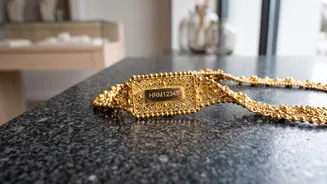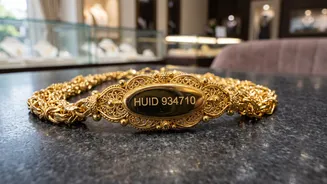







Buying gold jewellery in India is an act of love and a major financial decision. Now, a powerful tool from the Bureau of Indian Standards (BIS) puts the power of verification right in your hands, ensuring your precious purchase is exactly what it claims
to be.
Why Hallmarking is Your Guarantee
For years, the purity of gold was a matter of trust between you and your jeweller. This left consumers vulnerable to buying under-carated gold—jewellery sold as 22-karat that was actually less pure. To solve this, the Government of India made BIS hallmarking mandatory for gold jewellery in June 2021. A hallmark is an official certification that guarantees the purity of the gold has been tested and verified by an independent, BIS-licensed Assaying and Hallmarking Centre (AHC). It is a consumer's primary protection against being sold impure gold. As of 2026, mandatory hallmarking has been extended to 392 districts across India, covering most of the country's jewellery market.
Decoding the Modern Hallmark
Since April 2023, all new hallmarked gold jewellery must carry three specific marks that are laser-engraved onto the piece. Gone is the older, more confusing five-symbol system. The modern hallmark is simple and powerful: 1. The BIS Logo: A small triangle that confirms the piece was certified under the Bureau of Indian Standards system. 2. Purity and Fineness: This indicates the gold's purity. For example, '22K916' means the item is 22-karat gold, which is 91.6% pure. Other common purities include 18K750 (75% pure) and 14K585 (58.5% pure). 3. The HUID Number: This is the most critical feature for consumers. HUID stands for Hallmark Unique Identification, a six-character alphanumeric code (like AZ4K19) that is unique to every single piece of jewellery. No two items, not even in a pair of earrings, will have the same HUID.
Your Step-by-Step Verification Guide
The BIS Care App is a free mobile application that allows you to check the HUID yourself, right at the jeweller's counter. Here’s how to do it in under a minute: 1. Download the App: Search for 'BIS Care' on the Google Play Store or Apple App Store and install the official app published by the Bureau of Indian Standards. 2. Register Yourself: Open the app and complete a simple, one-time registration using your name and mobile number, which is verified with an OTP. 3. Select 'Verify HUID': On the app's home screen, tap the 'Verify HUID' option. 4. Enter the Code: Carefully type in the six-character HUID found on the jewellery. You may need a jeweller's loupe (magnifying glass) to read it clearly. Ensure you enter the letters and numbers correctly. 5. Check the Results: The app will instantly connect to the BIS database and display the details linked to that HUID.
Reading the Results: Green and Red Flags
When you verify a HUID, the app will show you several key details: the purity (e.g., 22K916), the type of article (e.g., ring, bangle), the jeweller who registered it, and the AHC that tested it. What you see on the screen should perfectly match the item in your hand and the details on the bill. A mismatch is a major red flag. For instance, if the app shows '18K750' but the jeweller claims the piece is 22K, you should stop the purchase. Similarly, if the HUID comes back as 'Not Found', it could be a typo, but if it still doesn't verify after re-entering, it suggests the HUID is not genuine. In such cases, you should not proceed with the purchase until the jeweller provides a clear explanation.
What to Do If Details Don't Match
If you discover a discrepancy through the app, your first step is to question the jeweller. If you are not satisfied with the response, you have official recourse. The BIS Care App has a built-in 'Complaints' feature. You can use it to lodge a formal complaint about mismatched or fake hallmarking. You will need to provide details like the jeweller's name, the HUID, and upload a photo of the item and the bill. BIS will then investigate the complaint, and if the jeweller is found to be at fault, they can face legal action. This system empowers you to hold sellers accountable and ensures the integrity of the hallmarking system.