





The After-Meeting Black Hole
Think about your last big team meeting. The energy was high, ideas were flowing, and someone was tasked with taking notes. But what happened next? More often than not, those sparks of genius get lost. Critical action items are buried in rambling paragraphs,
key decisions are paraphrased incorrectly, and the momentum from the discussion fizzles out within hours. The raw recording of a video call is even worse—a digital file that no one has the time to re-watch. This gap between conversation and execution is what we can call the 'after-meeting black hole,' a productivity drain that costs teams valuable time and brilliant insights. We manually transcribe, we summarise, we delegate, but the process is slow, tedious, and prone to human error. It’s a universal problem of the modern hybrid workplace.
Enter the AI Copilot
This is where AI workspace copilots are stepping in to fundamentally change the game. Don't think of these as just another chatbot. An AI copilot is an integrated assistant that works alongside you in your existing digital environment—your Microsoft Teams, your Google Workspace, your Notion or Slack. Instead of being a separate tool you have to open, it's embedded within the platforms you already use. Its primary function is to understand the context of your work and automate complex, time-consuming tasks. In this case, its job is to act as the most efficient project assistant you've ever had, one that listens to every word of your meeting and understands what needs to be done next.
From Voice to Velocity
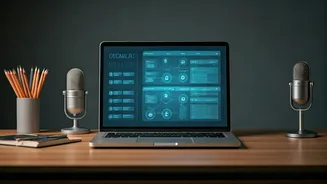
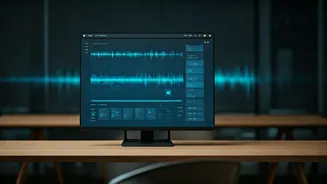
The process is as powerful as it is simple from the user's perspective. It starts with a recording of a meeting or a brainstorming session. The AI copilot first generates a clean, speaker-labelled transcript of the entire conversation. But this is just the beginning. The real magic happens in the next step. Using natural language processing (NLP) and large language models (LLMs), the AI analyses the transcript for intent and meaning. It identifies key themes, summaries of discussions, and most importantly, actionable tasks. It can distinguish between a casual mention and a direct assignment. For example, when someone says, “Priya, could you look into the Q3 budget numbers by Friday?”, the AI recognises this as a task, assigns it to 'Priya', and sets a deadline. It then automatically populates these findings onto a structured project board, like a Trello, Asana, or Jira-style layout. What was once a messy, hour-long audio file becomes a neatly organised board of tasks, complete with owners, deadlines, and relevant context pulled directly from the conversation.
The Real-World Productivity Payoff
The benefits for teams, particularly in fast-paced Indian startups and large enterprises, are immediate and substantial. Firstly, it saves an enormous amount of administrative time. The hours spent manually summarising notes and creating tasks are reduced to minutes. Secondly, it drastically improves accountability. When tasks are automatically captured and assigned, there's no more, “I don’t remember who was supposed to do that.” The AI-generated board provides a single source of truth. Thirdly, it preserves the richness of brainstorming. Ideas that might have been dismissed as minor points are captured and can be revisited later. This ensures that no creative spark is lost. Companies like Microsoft with its M365 Copilot, and collaborative platforms like Notion with Notion AI, are at the forefront of integrating these features, turning their applications from passive document holders into active participants in the workflow.
A Note of Caution
However, it's not a perfect utopia just yet. The effectiveness of these copilots is heavily dependent on the quality of the audio and the clarity of the speakers. Strong accents, background noise, or people speaking over each other can still confuse the AI, leading to transcription errors or misinterpreted tasks. There are also valid concerns around data privacy and security. Companies must be clear on where their conversational data is being stored and how it's being used by the AI model. Furthermore, this technology should be seen as an 'assistant', not a 'replacement' for human oversight. A final review of the AI-generated project board by a project manager or team lead is crucial to catch any errors and ensure the tasks align with strategic priorities. Human judgment remains the most important part of the process.