
The New King of the Moons
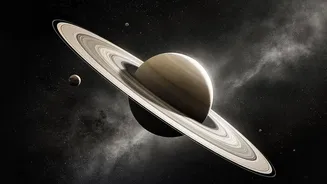
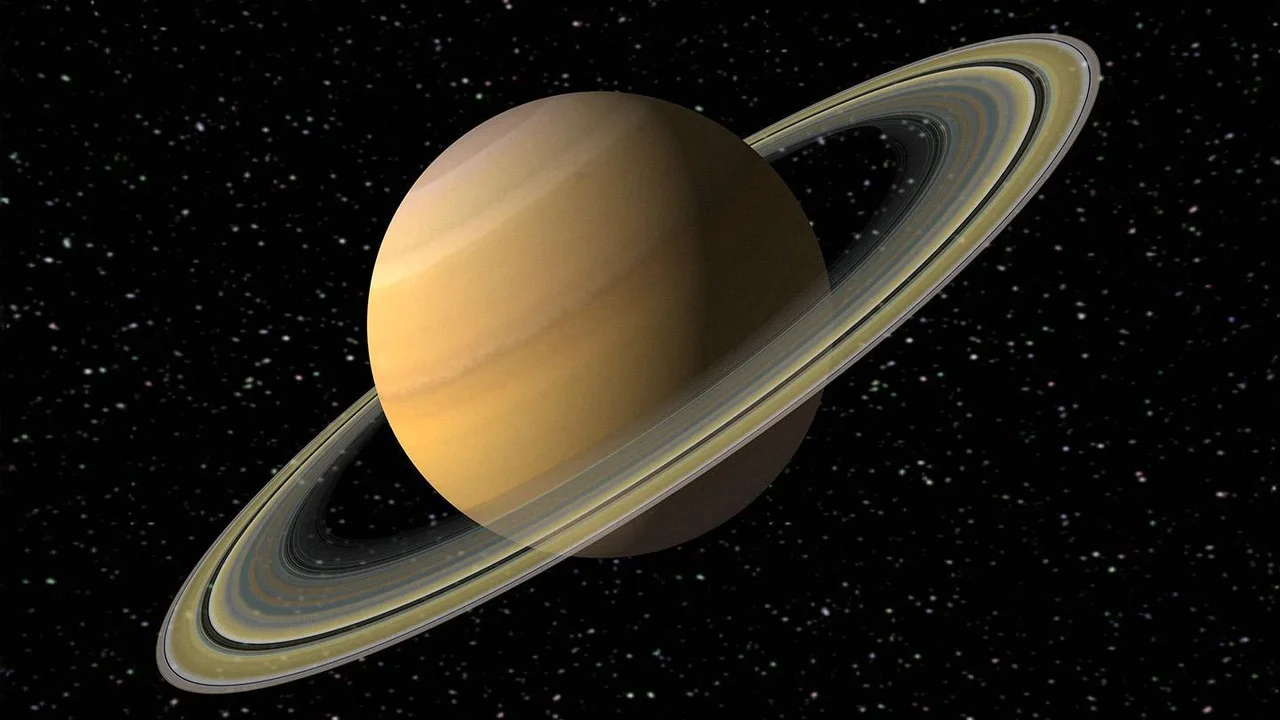
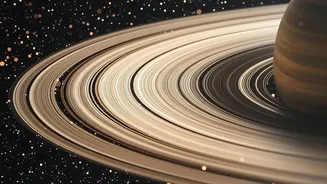
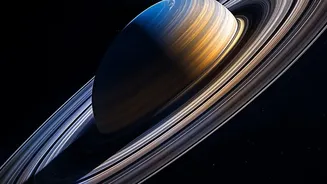
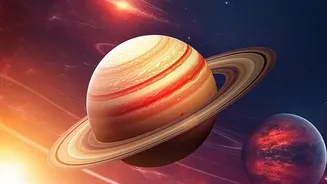
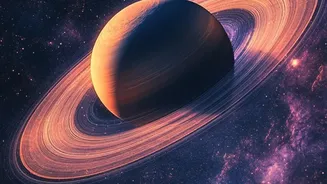
For decades, Jupiter held the title for the most known moons. But a series of recent discoveries has propelled Saturn into a decisive lead. Since May 2023, astronomers have announced huge batches of newly confirmed moons, culminating in the latest total
of 293. This surge didn’t happen because new moons suddenly appeared, but because our ability to see them has dramatically improved. Teams of scientists have been meticulously poring over images from powerful ground-based telescopes, finding objects once too faint to resolve. These announcements often come in waves, as confirming a moon’s orbit is a painstaking process that can take years of observation and analysis.
How to Find a Moon Hiding in Plain Sight
So, how do you find a moon that's just a few kilometres across and hundreds of millions of kilometres away? The secret lies in a clever technique called “shift and stack”. Astronomers take many images of a patch of sky over time. Because a potential moon is moving against the background of distant stars, it appears in a different spot in each frame. The shift-and-stack method involves digitally shifting each image to align with the moon's predicted path. When these adjusted images are stacked, the faint light of the tiny, moving object adds up, making it pop out from the background noise. It’s a computationally intensive process that has allowed scientists to find objects a hundred million times fainter than what the naked eye can see.
These Aren't Your Textbook Moons
Forget the large, spherical moons like Earth's. The vast majority of these new discoveries are what astronomers call "irregular moons." They are small, often just a few kilometres in diameter, with strange, elongated, and tilted orbits. Most of them are also in retrograde orbits, meaning they travel around Saturn in the opposite direction to the planet's rotation. These are not moons that formed alongside Saturn from a primordial disk. Instead, they are thought to be ancient objects—likely asteroids or comet-like bodies—that were captured by Saturn’s immense gravity long ago. While moons like Titan and Enceladus are fascinating worlds in their own right, with atmospheres and subsurface oceans, these small, irregular bodies tell a completely different story.
Echoes of a Chaotic Past
The real treasure in finding these moons isn't just cataloguing them, but understanding what they tell us about the solar system's violent history. Many of these irregular moons are found in distinct orbital clusters or "families." This clustering is a cosmic fingerprint, suggesting that these moons are the shattered remnants of a few larger parent bodies. Scientists theorise that one or more larger moons, captured by Saturn billions of years ago, were smashed apart by collisions with other moons or passing objects. Each fragment continued along a similar orbital path, creating the groups we see today. By studying these fragments, scientists can piece together the story of these ancient collisions, offering a glimpse into a time when the outer solar system was a much more chaotic and dynamic place.
Time Capsules of the Early Solar System
Ultimately, each of these tiny, irregular moons acts as a time capsule. Because they have remained largely unchanged since they were captured and broken apart, they preserve information about the conditions of the early solar system. Their composition and orbits provide crucial clues for modelling how the giant planets formed and migrated, and how their gravitational influence shaped the architecture of the entire system we see today. So, while the headline number of 293 is impressive, the real story is in the details—the orbits, the sizes, and the groupings that allow us to read the history of our solar system written in the sky around Saturn.