




The High-Altitude Advantage
The first and most critical factor is altitude. Locations like the Spiti Valley in Himachal Pradesh and the Changthang Plateau in Ladakh sit at elevations soaring between 10,000 and 15,000 feet. At these heights, you are above a significant portion of
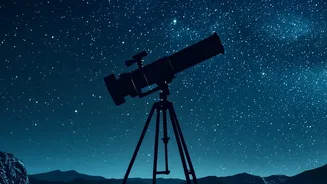
the Earth's atmosphere. A thinner atmosphere means less air to look through, which reduces the amount of distortion, blurring, and light absorption that hinders celestial viewing at sea level. This is why major research observatories, like the Indian Astronomical Observatory in Hanle, are built on these remote mountaintops. The pristine air provides a crystal-clear window to the cosmos, allowing stars to appear as sharp, brilliant points of light rather than twinkling blurs.
A Land in the Rain Shadow
These Himalayan regions benefit from a unique geographical feature: they are located in a 'rain shadow'. The towering Himalayan ranges block the moisture-laden monsoon clouds that affect most of the subcontinent from June to September. The result is a cold, arid desert landscape with exceptionally low humidity and over 250 clear nights a year. Dry air is crucial for astronomy because water vapor scatters starlight, creating a hazy, washed-out view. In places like Hanle and Spiti, the air is bone-dry, leading to what astronomers call excellent 'transparency'—an unobstructed path for light from distant galaxies to reach your eyes.
The Clarity of Winter's Cold
While these sites offer clear skies for much of the year, winter brings conditions to a peak. The bitterly cold air of the winter months can hold significantly less moisture than warmer air, further reducing humidity and atmospheric haze. This leads to exceptionally transparent skies where even faint deep-sky objects become visible. Furthermore, in the Northern Hemisphere's winter, Earth's night side faces away from the dense, hazy center of our own Milky Way galaxy and looks out toward the sparser edge of our galactic spiral arm. This creates a darker, higher-contrast backdrop that makes individual stars and constellations, like the brilliant Orion, stand out with breathtaking clarity.
Escape from Light Pollution
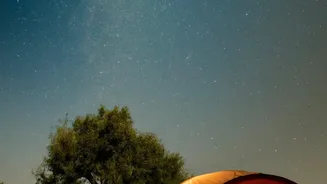
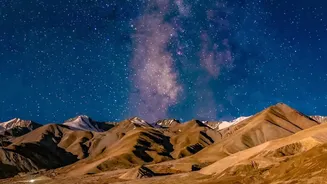
Perhaps the most obvious benefit of these remote locations is the near-total absence of light pollution. Most of the world's population lives under skies so brightened by artificial light that the Milky Way is completely invisible. In contrast, places like the Spiti Valley and the Hanle Dark Sky Reserve—India's first officially designated sanctuary for preserving the night sky—are rated as Bortle 1 or 2 sites. This is the darkest possible rating on the astronomical scale, signifying a sky so pristine that thousands of stars, constellations, and even other galaxies like Andromeda are visible to the naked eye.
Where to Experience the Spectacle
Two primary destinations stand out. The Spiti Valley in Himachal Pradesh is celebrated for its stunning landscapes, ancient monasteries, and accessible villages like Kaza, Komic, and Langza, which serve as bases for stargazers. It requires no special permits, making it a popular first choice for astrophotographers. For the ultimate pilgrimage, there is Hanle in Ladakh. Home to the Indian Astronomical Observatory, the area was formally established as a Dark Sky Reserve to protect its unique astronomical conditions for both scientific research and astrostourism. While more remote and requiring permits, Hanle offers what many consider the single best stargazing experience in all of Asia.