



The Surprising Weight of Your Waste
It might not feel like it, but the single biggest contributor to the weight of your household dustbin is organic waste. Studies across Indian cities show that wet waste, which includes everything from vegetable peels and leftover food to tea leaves and coffee
grounds, makes up 40% to 60% of the total municipal solid waste. This means that by simply diverting these food scraps, you could potentially cut the amount of trash you send to a landfill by half. This single change has a ripple effect, not just on overflowing landfills but on the very air we breathe.
Landfills and the Methane Problem
When food scraps are dumped in a landfill, they get buried under layers of other trash, cutting them off from oxygen. This creates an anaerobic environment where the organic matter decomposes by producing methane, a greenhouse gas. Methane is a climate super-pollutant, with more than 80 times the warming power of carbon dioxide over its first 20 years in the atmosphere. Your kitchen bin, when its contents end up in a landfill, is an unwitting contributor to this global problem. Composting completely changes this equation.
Composting: A Breath of Fresh Air
Composting is nature's own recycling process, and it's an aerobic one, meaning it requires oxygen. When you compost at home, you are creating a managed environment where microorganisms break down organic waste in the presence of air. This process produces a small, negligible amount of carbon dioxide instead of potent methane. You effectively stop the production of a powerful greenhouse gas at the source. The end product isn't waste; it's a rich, dark, soil-like material often called 'black gold' that is packed with nutrients for your plants.
Method 1: Classic Bin Composting
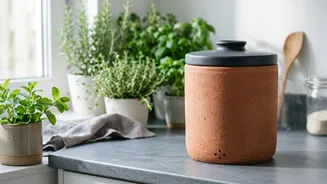
This is the most straightforward method, perfect for those with a balcony or a small outdoor space. You can use a simple terracotta pot (matka) with a hole at the bottom, or a dedicated composting bin. The key is to layer your 'greens' (nitrogen-rich food scraps like vegetable peels and coffee grounds) with 'browns' (carbon-rich dry materials like dried leaves, sawdust, or shredded cardboard). Keep the pile moist but not wet, and turn it every week or so to aerate it. In a few months, you'll have your first batch of compost.
Method 2: Vermicomposting for Apartments
If you live in an apartment with no outdoor space, vermicomposting is your answer. This method uses earthworms to break down your food scraps in a specialized bin. It's fast, completely odourless when done correctly, and takes up very little space. The worms eat through the scraps and produce 'castings', which are an incredibly potent and nutrient-dense fertilizer. You simply add scraps to the top tray of a worm bin, and the worms do all the work, migrating upwards as lower trays are converted into finished compost.
Method 3: The Bokashi Bucket System
The Bokashi method is a revolutionary approach that works well indoors. Originating from Japan, it isn't technically composting but rather a fermentation process. You add your food scraps—including items not suitable for other methods like meat and dairy—to an airtight bucket and sprinkle a special 'Bokashi bran' over each layer. The bran contains microbes that pickle the waste. The process is quick, taking only a couple of weeks, and produces no foul odours. The resulting fermented material can then be buried in garden soil or a larger compost pile, where it breaks down rapidly.