






The Limits of Radio Waves
Since the dawn of the space age, missions have relied on radio waves to send and receive data. While reliable, this method is hitting a bottleneck. As scientific instruments become more powerful, they generate enormous amounts of high-definition imagery
and data that traditional radio frequency (RF) systems struggle to transmit efficiently. Think of it like trying to stream a 4K movie over an old dial-up internet connection; the bandwidth simply isn’t there. For example, it can take hours for a high-resolution image from Mars to make its way back to Earth. This data traffic jam limits the pace of discovery and our ability to explore in real-time.
A Leap to Laser Light
The solution is to move from radio waves to light itself. NASA's Deep Space Optical Communications (DSOC) technology uses near-infrared lasers to transmit information. While both radio and infrared are forms of electromagnetic radiation that travel at the speed of light, infrared light has a much higher frequency. This allows engineers to pack significantly more data into each transmission. The result is a monumental increase in bandwidth, with data rates 10 to 100 times faster than the best RF systems. This leap is akin to switching from old telephone lines to modern fiber optics, enabling a new era of high-speed interplanetary communication.
How It Actually Works
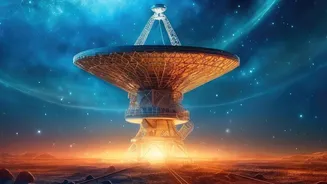
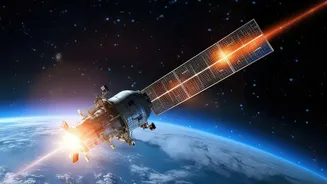
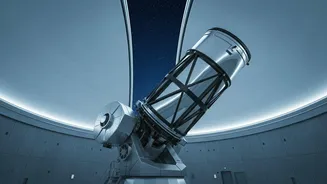
The process is elegantly complex. First, data is encoded into the photons of the laser beam. A flight laser transceiver aboard a spacecraft, like the one on NASA's Psyche mission, then beams this data toward Earth. To ensure the laser hits its target millions of kilometers away, the system relies on a ground-based uplink laser that acts as a beacon. The spacecraft's transceiver locks onto this beacon to precisely aim its own downlink beam. Back on Earth, a massive telescope, such as the Hale Telescope at Palomar Observatory, collects the faint laser light. This light is directed to a special detector made of superconducting nanowires that can count the individual photons, which are then decoded back into usable data.
Pinpoint Accuracy Over Millions of Kilometers
One of the greatest challenges is the incredible pointing accuracy required. Transmitting a laser beam over hundreds of millions of kilometers is like trying to hit a moving coin from a kilometer away. The system must account for the spacecraft's motion and the time it takes for light to travel. Earth's atmosphere can also distort the signal. To overcome this, the flight transceiver uses advanced systems to stabilize its view and correct for any platform vibrations. On the ground, powerful signal processing and highly sensitive detectors are needed to capture the faint signal and filter out noise from sunlight.
A Proven Game-Changer
This technology is no longer just theoretical. NASA's DSOC experiment, flying aboard the Psyche spacecraft, has already demonstrated its incredible capabilities. In one test, it streamed ultra-high-definition video from 19 million miles away at a rate of 267 megabits per second (Mbps), a speed comparable to terrestrial broadband internet. It has successfully transmitted data from as far as 226 million miles (363 million kilometers), a distance comparable to Mars at its farthest point from Earth. These tests prove that optical communications can provide the bandwidth needed for future missions, including those carrying astronauts.
The Future of Interplanetary Broadband
The success of laser communications opens up a universe of possibilities. Future human missions to Mars could stream live, high-definition video feeds, allowing for real-time collaboration with mission control. Robotic explorers could send back vast troves of scientific data far more quickly, accelerating discovery. Furthermore, the hardware for laser communications is typically smaller, lighter, and requires less power than comparable radio systems, which is a major advantage when designing spacecraft where every gram and watt counts. This technology is a critical step in building the infrastructure needed to support a sustained human presence beyond Earth.