







Inception (2010)
Christopher Nolan’s heist thriller isn't just about stealing secrets; it's about stealing them from within the layered architecture of dreams. The film introduces the concept of 'extraction'—entering someone's subconscious to retrieve information—and
the far more dangerous 'inception': planting an idea. Led by Dom Cobb (Leonardo DiCaprio), a skilled thief haunted by his past, a team ventures into a dream within a dream within a dream. Each level operates on different rules of time and physics, creating a complex, cascading structure that is as thrilling as it is intellectually demanding. The film constantly forces you to question what's real and what's part of the elaborate dreamscape, all culminating in a final shot that remains one of modern cinema's most debated endings.
Arrival (2016)
When twelve mysterious alien spacecraft touch down across the globe, linguist Louise Banks (Amy Adams) is tasked with the monumental job of figuring out how to communicate with them. This isn't a story of alien invasion but of intellectual and emotional discovery. The film brilliantly explores the Sapir-Whorf hypothesis—the idea that the language you speak shapes your perception of reality. As Louise learns the aliens' circular, non-linear language, her own experience of time begins to warp, leading to a stunning revelation that reframes the entire film. 'Arrival' is a poignant, beautifully crafted puzzle box that is less about 'what if they arrive?' and more about how we would change if we could understand them.
Blade Runner 2049 (2017)
Thirty years after the original, this visually breathtaking sequel expands on the neo-noir world of dystopian Los Angeles, a city of towering holographic ads and perpetual rain. The story follows K (Ryan Gosling), a new-generation android—or 'replicant'—who works as a Blade Runner, hunting down his own kind. His journey unearths a long-buried secret that threatens to shatter the fragile social order, forcing him to question his own identity, memories, and the very nature of a soul. More than just a visual spectacle, the film is a profound meditation on what defines humanity, freedom, and purpose in a world where the lines between organic and artificial life have all but disappeared.
Interstellar (2014)
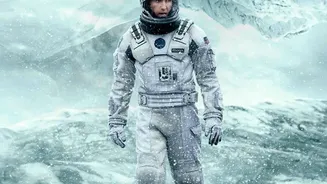
In a near-future where Earth is dying, a last-ditch mission sends a team of astronauts through a newly discovered wormhole to search for a habitable new home for humanity. 'Interstellar' is a film of immense scale, grounding its high-concept science—like time dilation on different planets and the physics of black holes—in a deeply personal story about a father's love for his daughter. The film visualizes complex scientific theories in a way that is both awe-inspiring and comprehensible. Cooper's journey into the unknown becomes a race against time itself, where an hour spent on one world can mean decades back on Earth. It's an epic that balances cosmic spectacle with raw human emotion.
Gattaca (1997)
In the not-too-distant future, society is driven by eugenics, where individuals are defined by their DNA. Those conceived naturally without genetic modification, known as 'in-valids', are relegated to menial jobs, while the genetically superior 'valids' hold all positions of power. The film follows Vincent Freeman, an 'in-valid' with a dream of traveling to space, who assumes the identity of a 'valid' to achieve his goal. 'Gattaca' is less about futuristic technology and more a tense, character-driven thriller about spirit versus science. It poses timeless questions about determinism, ambition, and whether our genetic makeup is all that we are. Its sleek, retro-futuristic aesthetic and powerful narrative have made it an enduring classic.