






Every year, World Food Day on October 16 prompts a vital question: how can a nation that produces so much food still face significant hunger? The answer is complex, but a major piece of the puzzle lies in what we throw away. It’s a paradox of overflowing
bins next to empty plates.
India's Staggering Scale of Food Waste
The numbers are difficult to comprehend. According to the UN Environment Programme's 2024 Food Waste Index Report, Indian households waste a staggering 78.2 million tonnes of food every year. This makes India the world's second-largest contributor to household food waste, behind only China. On an individual level, this amounts to approximately 55 kilograms of food thrown away per person annually. This waste occurs across the entire supply chain — from losses on the farm due to inefficient harvesting and storage, to spoilage during transport, and finally, the food discarded from our own kitchens and at events. While globally households are responsible for 60% of food waste, significant amounts are also lost in retail and the food service industry.
The Direct and Tragic Link to Hunger
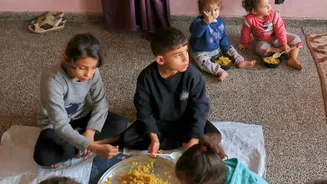
The most jarring consequence of this waste is its direct link to hunger. India is home to the world's largest population of undernourished people, with the 2023 Global Hunger Index ranking the country 111th out of 125 nations, indicating a 'serious' level of hunger. An estimated 233.9 million people in India are undernourished. There is a tragic irony in the fact that the food lost or wasted each year holds the potential to feed millions. Reports have estimated that saving even a fraction of the food currently lost could be enough to feed a vast number of hungry people. The problem is not a lack of food, but a massive gap in distribution and an acceptance of waste, creating a situation where surplus and starvation exist side-by-side.
The Hidden Climate Cost of a Full Bin
Beyond the humanitarian crisis, food waste has a profound environmental impact that often goes unseen. When food ends up in a landfill, it decomposes in an oxygen-free environment, a process that releases methane. Methane is a potent greenhouse gas, over 25 times more powerful at trapping heat in the atmosphere than carbon dioxide over the long term. Municipal landfills are a major source of human-caused methane emissions, and food scraps are the single largest component of the waste that goes into them. The U.S. Environmental Protection Agency found that food waste is responsible for an estimated 58% of fugitive methane emissions from landfills. If global food waste were a country, it would rank as the third-largest greenhouse gas emitter after the U.S. and China. This doesn't even account for the wasted resources—water, land, energy, and labour—that went into producing that food in the first place.
Forging a Path Forward in India
Tackling food waste requires a multi-pronged approach. The Indian government and organisations like the Food Safety and Standards Authority of India (FSSAI) have initiated programs like 'Save Food, Share Food' to create networks for surplus food donation. There is also a push to improve infrastructure, such as cold storage and better transportation, to prevent spoilage between the farm and the market. Technology offers new solutions, with apps that can connect restaurants with surplus food to NGOs that can distribute it. On a community level, food banks play a critical role, while composting initiatives can turn unavoidable food scraps into valuable resources for soil. Individual actions, like planning meals, buying only what is needed, and understanding date labels, are also crucial components of the solution.