


A New Material Language
When you picture high fashion, steel might be the last material that comes to mind. Yet, in the ateliers of India's most forward-thinking couturiers, it's becoming a star player. This isn't about crafting rigid, unwearable armour. Instead, designers are
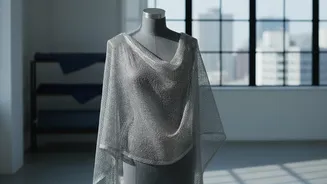
using hair-thin steel wires to create textiles that offer an entirely new vocabulary for fashion. These modern metallic fabrics are produced by weaving or knitting ultra-fine metal wires, sometimes on their own and other times blended with traditional threads, into a mesh-like cloth. The result is a material that holds its shape like no other, allowing for sculptural forms that defy gravity, while simultaneously possessing a liquid-like sheen and unexpected movement.
The Sculptural Pioneers
At the forefront of this movement are designers like Rimzim Dadu and Amit Aggarwal, who have made material innovation a signature of their brands. Dadu is renowned for her use of steel wire, which she meticulously transforms into wearable art. Her signature steel wire sari, famously worn by Sonam Kapoor at Cannes, demonstrated how an industrial material could be fashioned into a drape with a liquid-metal flow. In her recent 2026 couture collection, 'INLAE', Dadu paired her signature steel wire textiles with mother-of-pearl, drawing inspiration from Mughal inlay work to create surfaces with the intricacy of jewellery and the fluidity of fabric. The steel provides the structure, allowing the delicate mother-of-pearl to be engineered into grid patterns that move with the body.
Precision Meets Futurism
The use of metallic textiles allows for a level of precision that is difficult to achieve with conventional fabrics. Gaurav Gupta, another couturier known for his sculpted, futuristic silhouettes, employs metallic and polymer materials to create his dramatic, three-dimensional forms. His work often features otherworldly structures, from swirling drapes to crystallized corsets and armour-like breastplates, that explore themes of sci-fi and mythology. Similarly, Amit Aggarwal blends metallic polymers and meshes with traditional fabrics, engineering structured saree gowns and moulded blouses that are both futuristic and rooted in Indian silhouettes. This precision enables designers to construct garments that act as a second skin, sculpting the body and creating shapes that are sharp, architectural, and dynamic.
The Paradox of Fluid Movement
Perhaps the most captivating aspect of steel-wire textiles is the contradiction they embody: the combination of a hard material with graceful movement. The secret lies in the technique. The wires are woven into fine meshes or used as flexible cords, creating textiles that, from a distance, move and shift like fabric. This creates an illusion—what appears solid and structured one moment can ripple and flow the next. Rimzim Dadu’s work, in particular, focuses on making these unconventional materials feel fluid and effortless on the body. This dynamic quality gives the garments a life of their own, catching the light and transforming with every step the wearer takes, challenging our perceptions of what fabric can be.