




More Than a Museum Piece
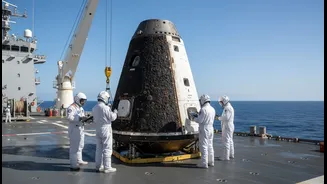
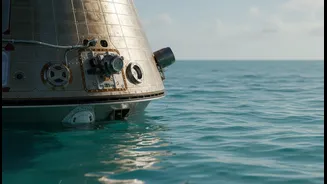
After its nearly 700,000-mile journey around the Moon and back, the Orion spacecraft isn't destined for a quiet retirement. Instead, it’s being treated like the most important black box in the world. Technicians at NASA's Kennedy Space Center are carefully
dismantling and analysing every inch of the capsule. This isn't just about checking for damage; it’s a deep, data-driven autopsy designed to validate the technologies that will carry the next astronauts to the lunar surface on Artemis III and, eventually, to Mars. Every scratch, every sensor reading, and every piece of worn material tells a story that engineers are desperate to read. This painstaking process is where the real success of Artemis II will be measured.
The Fiery Return Under Scrutiny
A primary focus of the post-flight inspection is Orion's heat shield. After the uncrewed Artemis I mission, engineers discovered unexpected erosion of the shield's ablative material. While that spacecraft returned safely, NASA couldn't risk sending a crew on Artemis II without understanding and mitigating the issue. The heat shield on the Artemis II capsule, which endured temperatures of around 5,000 degrees Fahrenheit during its screaming 25,000 mph reentry, is being meticulously examined. Initial reports show the char loss was significantly reduced compared to Artemis I, a huge validation for the engineering fixes put in place. Samples will be harvested and x-rayed to provide a complete picture of its performance, ensuring the shield is robust enough for the even more demanding missions to come.
The Digital and Human Story
Beyond the physical hardware, engineers are poring over terabytes of data recorded by thousands of sensors throughout the spacecraft. This includes everything from the performance of the life support systems, which sustained the four-person crew for ten days, to the navigation and propulsion systems. Even minor issues, like a small helium leak or a clogged waste vent, provided invaluable data for operational workarounds and future design improvements. Just as crucial is the data from the astronauts themselves. Medical checks and even a post-flight obstacle course help scientists understand how the human body copes with deep space travel beyond the protection of Earth's magnetic field, research that is vital for long-duration missions to Mars.
From II to III: Paving the Way
Every piece of information gleaned from the Artemis II checks has a direct impact on Artemis III, the mission slated to land humans on the Moon for the first time in over half a century. The data confirms that Orion's life support systems are ready for crewed missions and validates the performance of the modified heat shield. Furthermore, key components from the Artemis II capsule, including avionics and communications systems, will be refurbished and reused on the Artemis III vehicle. This process of reuse is not just about saving money; it’s about building a sustainable, repeatable flight system. It’s the difference between a series of one-off voyages and establishing a permanent pathway to the Moon.