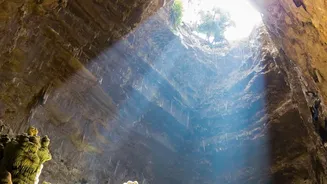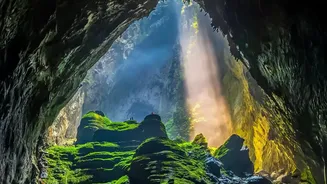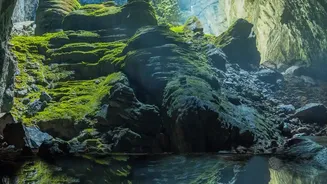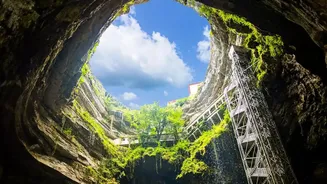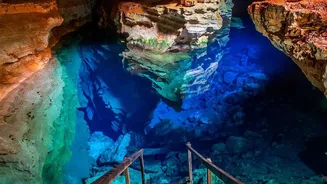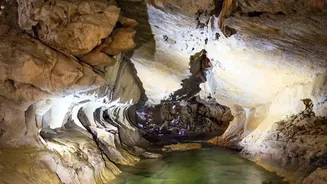




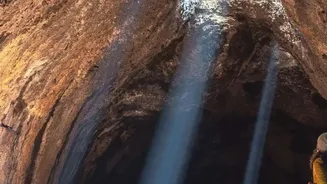
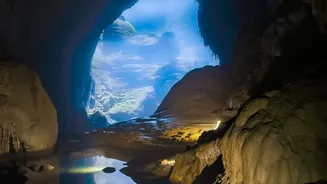
Beneath the rolling hills of Slovenia’s Karst region lies a world that defies imagination. It is a subterranean kingdom of vast halls and intricate sculptures, where a train journeys into the darkness and baby dragons are more than legend.
A Train Ride to the Center of the Earth
The adventure
at Postojna Cave begins not with a descent on foot, but with a train ride. For over 140 years, a railway has been whisking visitors deep into the mountain's core, making it the only cave in the world with a double-track railway. The open-air carriages navigate through a 3.7-kilometre network of tunnels, revealing the first glimpses of this underground wonderland. The train zips past galleries adorned with calcite formations and into enormous chambers, including one so grand it is illuminated by Murano glass chandeliers and known as the Dance Hall. This unique journey sets the stage for the walking tour, making the very act of entering the cave an experience in itself.
A Gallery Sculpted by Water and Time
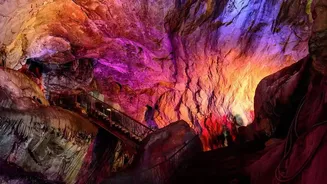
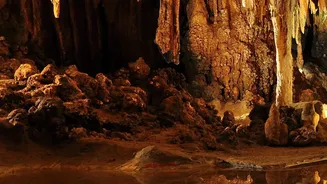
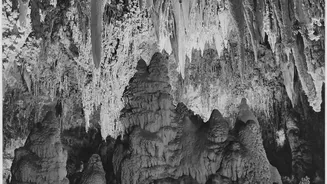
Once off the train, you step into a realm sculpted over millions of years by the patient drip of water. The 1.5-hour guided walk takes you through a series of breathtaking chambers, each with its own character. You'll wander through the Spaghetti Hall, with its ceiling covered in countless, delicate, noodle-like stalactites, and the Red and White Halls, named for the distinct colours of their limestone formations. The scale is immense, with some caverns large enough to feel like subterranean cathedrals. It's a testament to the slow, powerful artistry of nature, where it can take centuries for a formation to grow by a single centimetre.
The Brilliant: A Gleaming Underground Icon
Among the countless formations, one stands apart as the undisputed symbol of Postojna Cave: the Brilliant. This magnificent, five-metre-tall stalagmite gleams with a pure white colour, a result of a thin layer of calcite deposited by the steady dripping of water. Standing next to an ornate, column-like formation, the Brilliant's bright, almost glowing appearance makes it a focal point of the tour and a perfect example of the cave's stunning beauty. It has become an icon not just for the cave but for the entire Slovenian Karst region, a dazzling masterpiece in a gallery of natural wonders.
Meet the Cave's Most Mysterious Resident
Postojna Cave is not just a geological marvel; it is a cradle of speleobiology, home to over 150 animal species. The most famous resident is the olm (Proteus anguinus), an aquatic salamander affectionately known as the 'human fish' or 'baby dragon'. Adapted to a life of complete darkness, this pale, blind creature can live up to 100 years and survive without food for more than a decade. For centuries, when heavy rains washed them to the surface, locals believed they were the offspring of a dragon living within the mountain. Today, visitors can see these fascinating creatures in a specially designed aquarium, offering a glimpse into the unique biodiversity that thrives in this subterranean world.
The Heart of the Karst Region
Postojna is the crown jewel of Slovenia's Karst plateau, a limestone landscape that gives its name to this type of topography worldwide. The region is riddled with thousands of caves, underground rivers, and sinkholes, formed as water dissolves the soluble rock. The Pivka River carved out the 24-kilometre long Postojna system, creating one of the most accessible and impressive examples of this geological process. A visit to the cave is also an introduction to this wider landscape, which includes other natural wonders like the dramatic Škocjan Caves and the stunning Predjama Castle, a fortress built into the mouth of a cave just a few kilometres away.