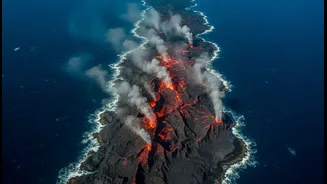









A Plate Is Breaking in Two
The focus of this intense scientific interest is the India-Australia-Capricorn tectonic plate. For a long time, it was considered a single, cohesive unit. However, powerful earthquakes in 2012 that occurred strangely in the middle of the plate, rather
than at its edge, revived a debate among scientists. Research now confirms that this massive plate is not uniform; different parts are moving at different speeds, causing it to split apart. This is an incredibly slow process, happening at a rate of about 1.7 millimetres per year. At this speed, it would take a million years for the two new pieces to be just 1.7 kilometres farther apart. While slow, this movement is significant because it's creating what could become a new plate boundary in the Wharton Basin.
Listening to the Deep
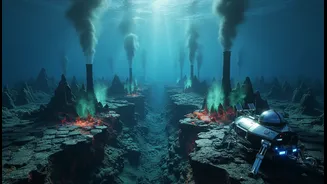
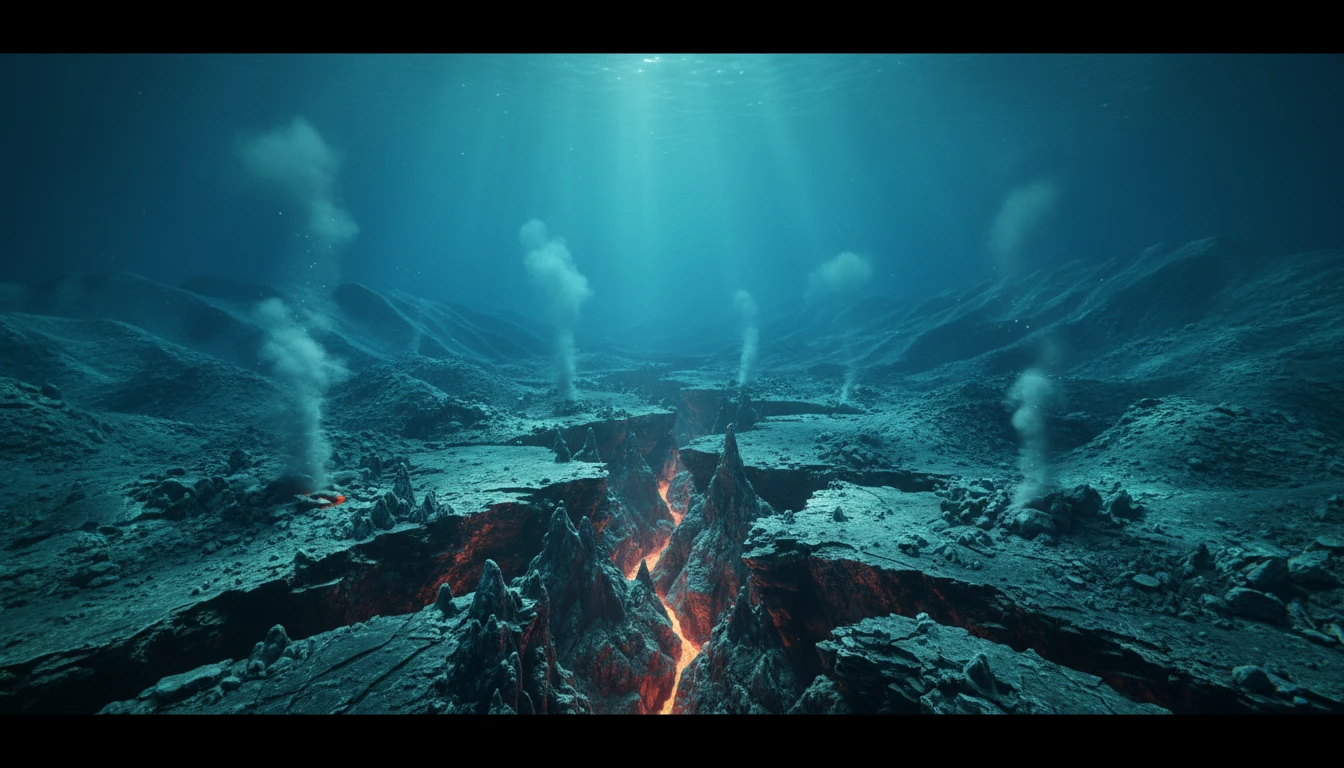
For the first time, scientists have captured a seafloor spreading event in real-time. In April 2024, at the Southeast Indian Ridge, an international team observed the seafloor split, sink by up to four metres, and release around 160 million cubic metres of lava. This historic observation was made possible by an advanced underwater observatory network deployed just two months earlier, part of the OHA-GEODAMS experiment. This network includes a variety of instruments like hydrophones (underwater microphones that detect seismic waves), pressure gauges, and seafloor mapping tools. In India, the National Centre for Polar and Ocean Research (NCPOR), under the Ministry of Earth Sciences, is a key agency in studying the Indian Ocean ridges, using similar geophysical survey techniques to explore these dynamic zones. Another innovative technique involves using existing subsea fibre-optic internet cables as a vast array of sensors, capable of detecting seismic vibrations and pressure changes across the ocean floor.
From Spreading to Shaking
The link between slow seafloor spreading and sudden earthquakes is all about stress. As tectonic plates move, stress builds up along fault lines. Seafloor spreading events, even slow ones, are part of this process. The groundbreaking 2024 observation showed that the seafloor can grow in sudden, massive lurches rather than a slow crawl, releasing strain that has built up over decades in just a matter of days. This research helps solve a long-standing mystery: the numbers never quite added up when scientists compared the movement from recorded underwater earthquakes with the actual speed of tectonic plates. This new data shows how the Earth's crust is shaped by both seismic tremors and 'aseismic' slip—fault movement without earthquakes—providing a much clearer picture of how and where stress accumulates and is released. This detailed understanding is crucial for improving long-term hazard assessments for coastal regions around the Indian Ocean, which are vulnerable to tsunamis generated by underwater earthquakes.
The Elusive Goal of Prediction
This brings us to the critical distinction between forecasting and prediction. While this research dramatically improves our ability to model tectonic stress and identify high-risk zones, it does not mean we can predict the exact time and place of a future earthquake. Scientists are firm that specific earthquake prediction remains out of reach for the foreseeable future. The processes deep within the Earth are incredibly complex. However, this new knowledge enhances our ability to make probabilistic forecasts—for example, stating the percentage chance of a large earthquake in a given region over several decades. Recently, artificial intelligence has been used to detect hidden 'slow-slip events' that might precede larger quakes, but even these warning signs are not consistent. So while the holy grail of prediction remains elusive, the gains in monitoring and hazard assessment are very real.
Real-World Gains Beyond Prediction
The benefits of this undersea research extend far beyond earthquake science. Improved monitoring helps safeguard critical infrastructure, particularly the vast network of subsea fibre-optic cables that carry the world's internet traffic. Understanding seafloor instability is vital for protecting these lifelines. Furthermore, the technology used for seismic monitoring, like hydrophone arrays and pressure gauges, is essential for improving tsunami warning systems. After the devastating 2004 Indian Ocean tsunami, there was a major international push to establish better warning infrastructure, and these latest scientific advances contribute directly to that effort. This research also opens new windows into deep-sea ecosystems, particularly around hydrothermal vents, which host unique life forms. By studying how new crust is formed, scientists gain fundamental knowledge about how our planet works, from its deepest interior to the oceans that cover its surface.