






A Cosmic Oddity
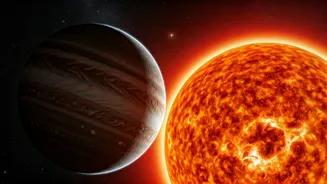
Imagine an object that exists in the twilight zone between a planet and a star. That’s a brown dwarf. These celestial bodies are more massive than giant planets like Jupiter but not quite massive enough to ignite the nuclear fusion that would make them
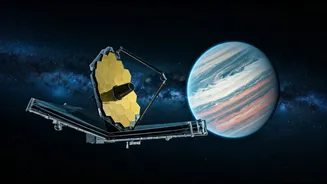
a star, earning them the nickname 'failed stars'. They are born like stars, from collapsing clouds of gas and dust, but they never quite make the cut. The James Webb Space Telescope (JWST) has been peering into the lives of these enigmatic objects, and it recently stumbled upon one that is truly perplexing. Located over 40 light-years from Earth, a brown dwarf known as W1935 is rewriting the rules.
The Case of the Unexpected Glow
Astronomers were studying a dozen cold brown dwarfs when they noticed something strange about W1935. It had a near-identical twin, W2220, with a similar temperature, brightness, and chemical makeup, including water, ammonia, and carbon dioxide. But one crucial difference set W1935 apart. While its twin absorbed light at the wavelength of methane, as expected for a cold object, W1935 was emitting light from its methane. This emission suggests that something is heating its upper atmosphere, but with no host star nearby to provide energy, the source of this heat was a profound mystery.
A Planet-Like Light Show
The leading theory for this unexpected methane glow is an aurora. On Earth, we see aurorae—the Northern and Southern Lights—when energetic particles from the Sun are captured by our planet’s magnetic field and slam into our atmosphere. Other planets in our solar system, like Jupiter and Saturn, also have aurorae. But W1935 is an isolated object; it has no star bombarding it with a solar wind. This makes the discovery of a potential aurora so baffling. It’s like finding a lighthouse shining in the middle of a desert, with no ocean in sight. This gives W1935 a split personality: it’s a star-like object exhibiting a quintessentially planet-like phenomenon.
Solving the Split Personality
So, if there's no star, what could be powering W1935's aurora? Scientists have a few ideas. The energy might come from an internal process within the brown dwarf itself, though the mechanism is not yet understood. Another intriguing possibility is that W1935 has an active, undiscovered moon. In our own solar system, Jupiter's volcanic moon, Io, spews particles that contribute to Jupiter's powerful aurorae. It's possible that a similar moon is orbiting W1935, providing the raw material for its mysterious light show. This would be a spectacular confirmation, extending a known solar system process to an isolated object far out in the galaxy.
Why This Discovery Matters
The case of W1935 is more than just a cosmic curiosity. It pushes the boundaries of our understanding of both brown dwarfs and planetary atmospheres. These 'failed stars' are proving to be far more complex and active than previously thought. The discovery of a starless aurora forces astronomers to rethink how such phenomena can be generated, potentially revealing new physical processes at work in the universe. It highlights how much we still have to learn about the objects that occupy the grey area between stars and planets. The powerful infrared vision of the James Webb Space Telescope was essential for this discovery, spotting details that were impossible to see with previous instruments.