







The Search for Lunar Gold
For decades, scientists have theorized that vast quantities of water ice are hidden on the Moon. This isn't just about quenching an astronaut's thirst; it's the key to a sustainable lunar economy. Through a process called electrolysis, this water can
be split into hydrogen and oxygen, the two primary components of powerful rocket propellant. This concept, known as in-situ resource utilization (ISRU), would transform the Moon from a desolate rock into a cosmic gas station, dramatically lowering the cost of missions to Mars and beyond. The most promising locations for this lunar gold are permanently shadowed regions (PSRs) near the poles—craters so deep their floors haven't seen sunlight in billions of years, making them cold enough to trap ice. Finding and tapping into these reserves is a top priority for space agencies like NASA and a host of commercial companies.
An Inconvenient Byproduct
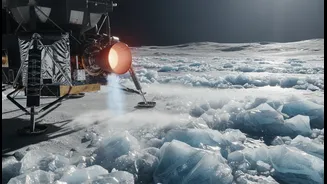
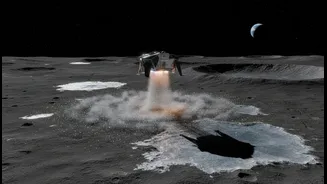
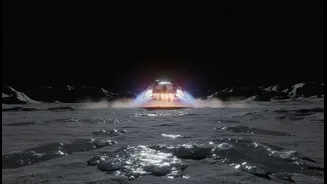
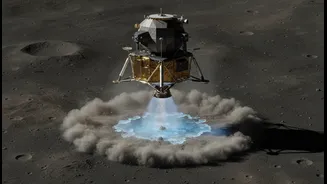
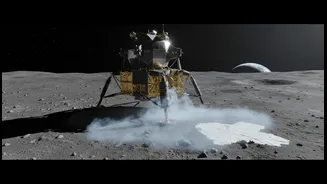
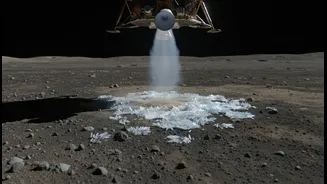
The next generation of lunar landers, including powerful vehicles like SpaceX's Starship, are designed to use liquid methane and liquid oxygen as fuel. This combination is efficient and seen as a key technology for future deep-space missions. However, it comes with a significant side effect. The exhaust from these powerful engines releases massive amounts of gases, including methane and, as a combustion byproduct, water vapor. A recent study highlighted that a single large lander could deposit more than 10 metric tons of water into the lunar environment. This poses a serious scientific problem. These pristine ice deposits in the PSRs are not just a resource; they are a scientific treasure chest, potentially holding clues about the formation of our solar system and the origins of life on Earth. The introduction of human-made water and other organic molecules like methane could contaminate this ancient record, making it difficult for scientists to distinguish between what is naturally there and what we brought with us.
Hops, Skips, and Ballistic Jumps
This is where the science gets fascinating. A new study published in the Journal of Geophysical Research: Planets modeled what happens to exhaust gases like methane in the Moon's airless environment. On Earth, gases are slowed down and contained by our thick atmosphere. On the Moon, there's virtually nothing to stop them. Molecules of methane, energized by sunlight, don't float away; they perform a series of "hops" across the surface in a process called ballistic migration. The simulations showed that methane released from a landing near the South Pole could travel all the way to the North Pole in less than two lunar days. Within about seven Earth months, over half of the released methane could become trapped in the ultra-cold PSRs at both poles. This surprisingly rapid and widespread distribution means that no landing site is truly isolated; our footprint will spread across the entire lunar surface.
Turning a Problem into a Solution
While the contamination risk is real, understanding this migration process provides a powerful new tool. By studying how methane—a key component of lander exhaust—moves and settles, scientists are not just learning how to predict and mitigate our own pollution. They are also gaining invaluable insights into how naturally occurring volatile substances, like water molecules, might travel and accumulate on the Moon. The physics that governs a methane molecule hopping across the surface is similar to the physics that governs a water molecule. Therefore, the computer models developed to track exhaust can be adapted to refine the search for natural water ice deposits. By understanding how our artificial volatiles spread, we can create better maps of where natural volatiles are most likely to be concentrated. It turns a potential contaminant into a crucial clue, helping to make the expensive and difficult task of prospecting for lunar water much more efficient.