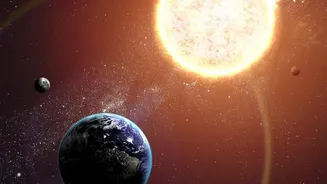


For centuries, we’ve pictured our solar system as a predictable, clockwork machine. But new research suggests this vision of long-term stability may be wrong, and the giant planets could be headed for chaos much, much sooner than we ever imagined.
The Old View of Stability
The
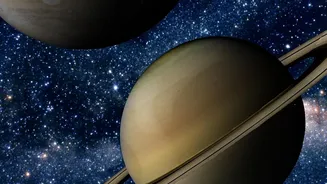
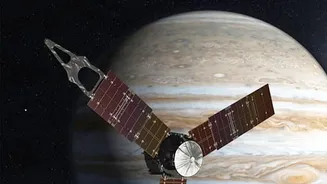
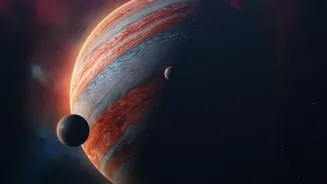
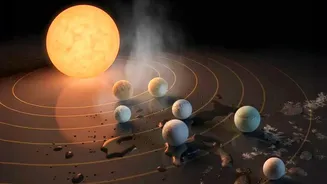
question of our solar system's long-term stability has intrigued astronomers since the time of Isaac Newton. The classical view, reinforced over decades, was one of incredible endurance. While the inner planets like Earth and Mars have always been known to have chaotic orbits, the system as a whole was believed to be stable for an almost unimaginable stretch of time. Previous simulations suggested that even after our Sun dies in about five billion years, the giant outer planets—Jupiter, Saturn, Uranus, and Neptune—would continue in their predictable paths for as long as 100 billion to a quintillion years. The prevailing theory was that the Sun would shed its mass smoothly as it evolved into a white dwarf, allowing the giant planets to drift into wider, but still stable, orbits.
A New Cosmic Wrinkle
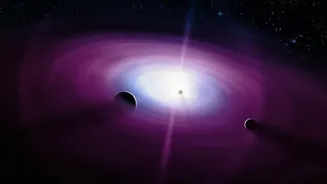
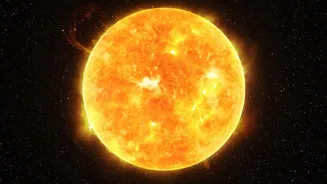
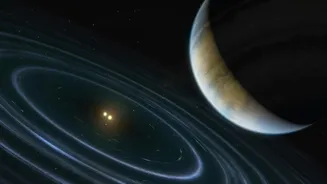
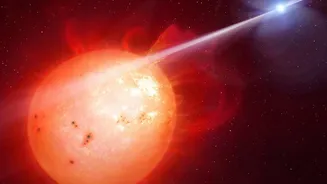
A recent study published in The Astrophysical Journal Letters has thrown a wrench into those long-held assumptions. A team of researchers, including Konstantin Batygin at the California Institute of Technology, decided to model the end of the Sun's life differently. Instead of assuming the Sun will lose mass in a smooth, consistent manner, they simulated a more realistic, violent process. Their model shows the dying Sun casting off its mass in thousands of random, uneven bursts, giving the star itself a series of tiny 'kicks'. These accumulated kicks, though small individually, introduce a new level of chaos into the gravitational dance of the outer planets.
How Soon is 'Much Earlier'?
The results of these new simulations are dramatic. Instead of surviving for tens or hundreds of billions of years post-Sun, the study found that the outer solar system could become unstable within just one billion years after the Sun becomes a white dwarf. This shortens the previously estimated lifespan by a factor of a billion. In hundreds of computer simulations run by the researchers, a significant percentage showed major disruptions. Some scenarios even showed instability beginning while the Sun is still in its red giant phase, before it becomes a white dwarf at all. In roughly 40% of these simulations, the outer planets were thrown into disarray during this earlier stage.
A Dance of Gravitational Chaos
The potential outcomes are startling. The simulations showed planets being completely ejected from the solar system, with Saturn sometimes getting kicked out entirely. In other scenarios, Uranus and Neptune were shown swapping their orbital positions. The random kicks from the dying Sun can nudge the giant planets into what are known as 'mean-motion resonances', where their orbital periods lock into simple ratios. This gravitational locking can amplify small instabilities over millions of years, leading to the erratic behavior seen in the models. It’s a powerful reminder that the cosmos is not a static place, but one defined by constant, chaotic evolution.
Should We Be Worried?
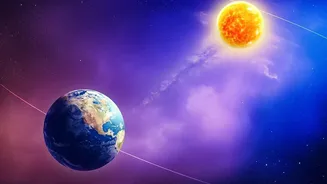
In short, no. This is a forecast for the far, far future. Humanity, and even Earth itself, will be long gone before any of these events unfold. Our Sun is expected to swell into a red giant in about five billion years, a process that will boil the oceans and make life on Earth impossible, likely consuming the planet altogether. This new research concerns the fate of the gas giants in the billions of years after that. What these findings truly change is not our future, but our understanding of the fundamental physics governing planetary systems and the ultimate fate of our cosmic neighborhood. It shows that our knowledge is always evolving as our tools and models become more sophisticated.