

Reading Between the Grains
For decades, the Moon was considered a completely dry, desolate world. However, data from multiple missions, including India's Chandrayaan-1, confirmed the presence of hydrogen, a likely sign of water ice, particularly in permanently shadowed craters
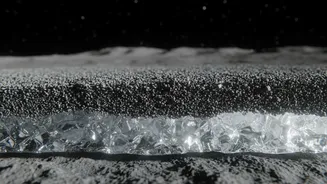
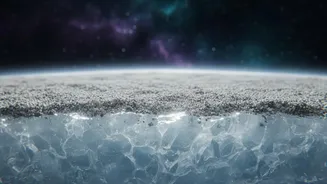
near the lunar poles. The challenge is that this ice isn't a vast, frozen lake on the surface. Instead, it's thought to be mixed in with the lunar soil, known as regolith, perhaps as small crystals or chunks. Finding the richest deposits is critical for future missions that hope to harvest this water for drinking, creating breathable air, or producing rocket fuel. But landing in every dark crater to drill for samples is impractical. This is where the structural mechanics of the soil itself—how it’s packed, its density, and how it behaves under stress—comes into play as an ingenious mapping tool.
The Tell-Tale Stiffness of Icy Soil
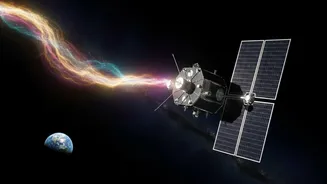
Recent research and laboratory experiments have provided a crucial insight: soil mixed with ice behaves differently than dry soil. Think of it like the difference between a bucket of dry sand and a bucket of sand mixed with frozen water. The icy sand is harder, stiffer, and more solid. On the Moon, this principle can be used to hunt for ice from afar. One promising method involves studying how seismic waves—vibrations from moonquakes or artificially created by landers—travel through the ground. Studies show that these waves would travel two to three times faster through ice-rich regolith because the ice acts as a cementing agent, stiffening the soil. An instrument on the lunar surface could detect these speed changes, revealing where stiff, potentially ice-rich zones are located deep beneath the surface.
New Tools for a New Frontier
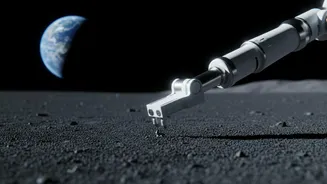
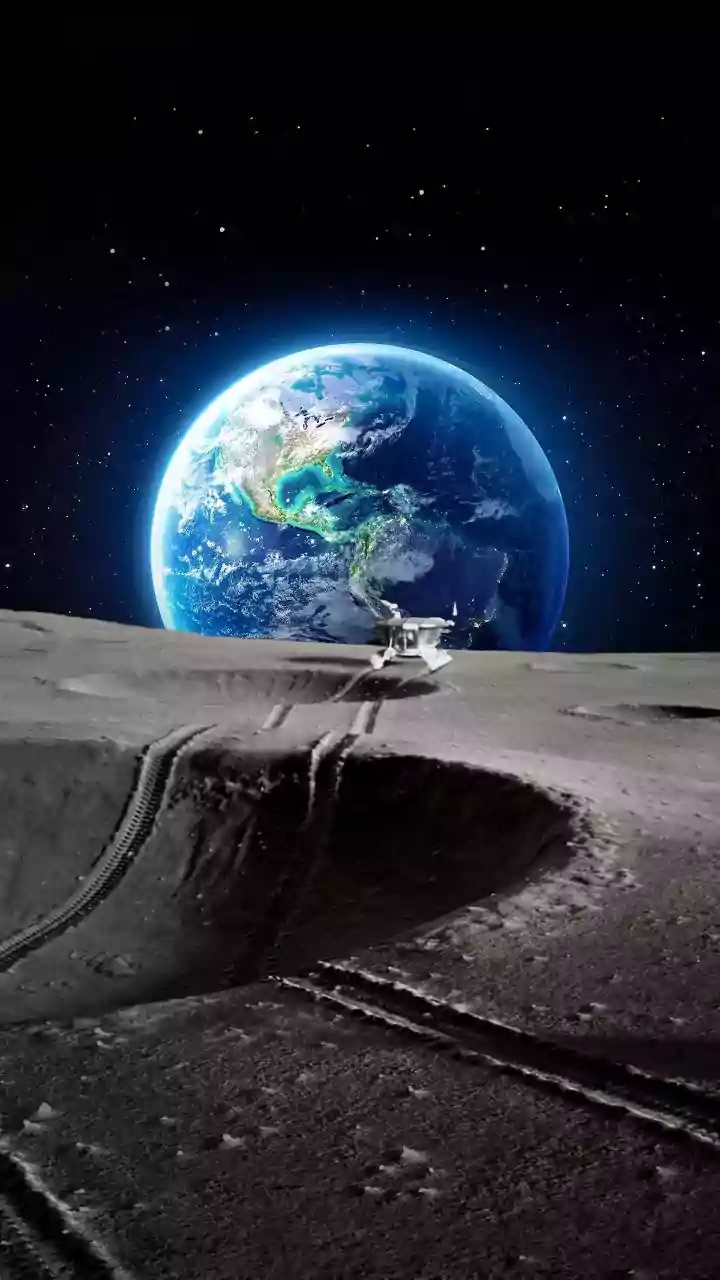
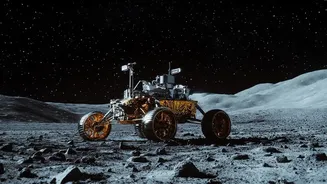
This indirect detection method is at the heart of future missions. NASA's now-discontinued but influential VIPER rover was designed to be a resource-mapping pioneer. It was equipped with a drill and spectrometers to directly analyze the soil, but its design was also informed by the need to understand the physical properties of the terrain it traversed. Testing for the mission involved creating simulated lunar soil to see how a rover would handle different conditions, from loose dust to harder, icier ground. India's Chandrayaan-3 mission, which successfully landed near the south pole, also provided vital ground-truth data. Its ChaSTE instrument measured the temperature profile of the top layer of regolith, finding that it provides excellent insulation, which could allow ice to exist surprisingly close to the surface even in areas that receive some sunlight. This data helps refine models of where to look for accessible ice.
From Soil Mechanics to Resource Maps
Other techniques also leverage soil properties. Passive microwave radiometry, for example, can detect changes in the thermal emissions from the ground. A layer of ice buried in the regolith will alter the brightness temperature that a sensor sees, providing another clue to its presence. By combining data from different instruments—seismic, thermal, and radar—scientists can build a multi-layered understanding of the subsurface without needing to drill everywhere. The structural properties of the soil—its strength, how it fails under pressure, and its density—are all affected by the presence of water ice. Laboratory experiments using lunar soil simulants have shown that even a small percentage of ice dramatically changes the soil's mechanical behaviour, making it harder to excavate. This is crucial information not just for finding ice, but for designing the future drills and robotic miners that will need to extract it.
Why This Changes the Game
Understanding lunar soil mechanics is about more than just geology; it's about economics and logistics. Creating detailed resource maps using this data will allow future missions, including NASA's Artemis program, to choose landing sites with the highest probability of accessible water. This drastically reduces mission risk and cost. Instead of a wild guess, landing sites can be chosen with statistical confidence. Water on the Moon is a game-changer, enabling the establishment of permanent bases and refueling stations for missions deeper into the solar system. By learning to read the story told by the lunar soil itself, space agencies around the world are paving the way for a sustainable human presence beyond Earth. The new data isn't just about rocks and dust; it's a blueprint for the future of space exploration.