

The Ghost of an Empire
For nearly 140 years, until the capital shifted to Delhi in 1911, Calcutta was the epicentre of the British Raj. This legacy is etched into the very blueprint of the city, particularly in its architecture. The British built not just to administer but
to impress, creating a 'City of Palaces' with structures that blended European styles like Neoclassical, Gothic, and Victorian with Indo-Saracenic elements. This fusion was a statement of power, an attempt to recreate a London-esque grandeur on Indian soil. Today, these buildings are more than stone and marble; they are the tangible ghosts of an empire, shaping the city's character and offering a direct line to its complex past. Exploring them is to understand how Kolkata became the city it is today.
The Administrative Heart: B.B.D. Bagh
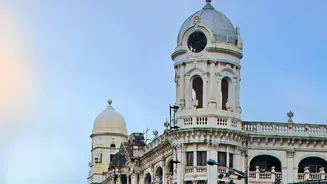
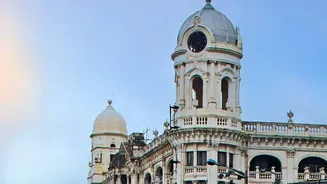
Now known as Benoy-Badal-Dinesh Bagh (B.B.D. Bagh), Dalhousie Square was the undisputed heart of British India. This area remains one of South Asia’s most intact colonial centres, a treasure trove of administrative architecture. The most dominant of these is the Writers' Building. Originally built in 1777 to house the junior clerks or 'writers' of the East India Company, its red-brick Greco-Roman facade stretches 150 metres long, a symbol of bureaucratic might. Nearby, the magnificent General Post Office (GPO) stands with its towering dome and Corinthian columns, while the Calcutta High Court showcases a Gothic Revival style. To walk through B.B.D. Bagh today, amidst the hustle of modern commerce and government work, is to feel the immense scale of the colonial enterprise; it is less a sightseeing tour and more an immersion into the very engine room of the Raj.
Victoria Memorial: Monument and Meeting Point
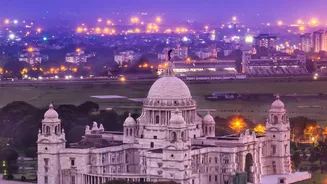
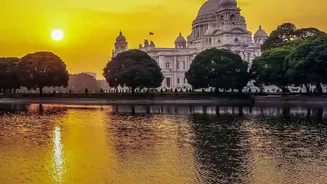
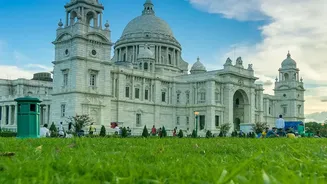
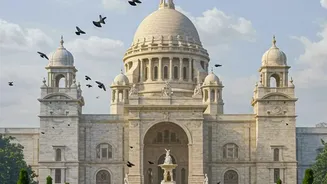
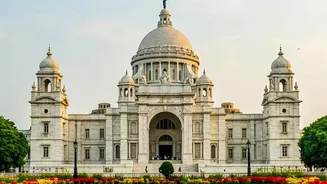
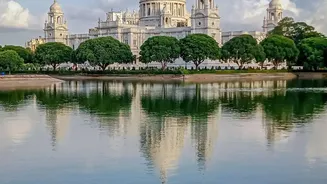
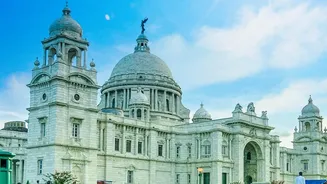
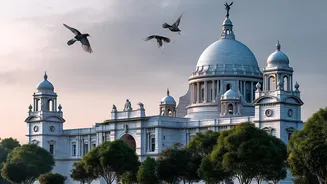
Perhaps no structure is more synonymous with Kolkata than the Victoria Memorial. Envisioned by Lord Curzon after the Queen's death, this sprawling white Makrana marble monument was designed to be 'stately, spacious, monumental and grand'. Opened in 1921, its design is a majestic blend of British, Mughal, Venetian, and other architectural styles. While it functions as a museum housing artifacts from the colonial period, its true role in the city's life transcends its exhibits. The vast 64-acre gardens surrounding the hall are Kolkata's lungs and its social hub. Families picnic on the lawns, friends gather by the water bodies, and classical concerts are held in its quadrangles. The Victoria Memorial is the ultimate proof that a 'sight' can evolve into an 'experience'—it is not just looked at, but lived in and around, making it the most visited museum in India.
The Living Heritage of North Kolkata
Beyond the formal British-built areas, the architectural experience extends deep into the narrow lanes of North Kolkata. This is the realm of the 'babus', the wealthy Bengali elite whose fortunes were often tied to the British. Here, a unique architectural fusion emerged. Grand mansions, known as 'Thakurbaris' or 'Rajbaris', combine European neoclassical elements like Corinthian columns and sprawling courtyards with traditional Bengali layouts. Structures like the Jorasanko Thakur Bari, the ancestral home of the Tagore family, and the Sovabazar Rajbari are not just buildings; they are cultural landmarks where the Bengal Renaissance unfolded. Many of these mansions show signs of age, their faded elegance telling stories of changing fortunes. Walking through these neighbourhoods is an intimate experience, offering a glimpse into a world shaped by the complex cultural interplay of the colonial era.
A Dialogue with Decay and Time
Part of what makes Kolkata’s architectural legacy an experience is that it is not perfectly preserved. Many buildings are in a state of 'managed decay', their crumbling facades and weather-beaten walls telling a story of time, neglect, and resilience. This is not an open-air museum where every exhibit is pristine. Instead, structures are still in use, repurposed, or simply aging alongside the city's residents. This ongoing dialogue between the past and the present, between grandeur and decay, is what gives the city its unique, melancholic charm. Architectural historian Philip Davies noted that Kolkata has an unparalleled collection of heritage buildings but is 'stumbling toward the future rather than grasping the spectacular opportunities afforded by its heritage'. This very imperfection, this sense of a 'sleeping giant', is integral to the experience. It invites you to look closer, to imagine the stories held within the walls, and to see history as a living, breathing entity.