



What is the SKA?
The Square Kilometre Array isn't a single telescope you can point at the sky. It's a revolutionary observatory made of two distinct telescopes spread across two continents. The name comes from its ultimate goal: to create a total collecting area of one
square kilometre, making it the most sensitive radio telescope ever built. Construction officially began in late 2022 in the radio-quiet deserts of South Africa and Western Australia. These locations were chosen for their remoteness, far from the radio interference of modern cities, to give astronomers the clearest possible view of the cosmos. The entire operation is a massive international collaboration, with its headquarters at the Jodrell Bank Observatory in the UK and more than a dozen member countries, including India.
Two Telescopes, One Mission
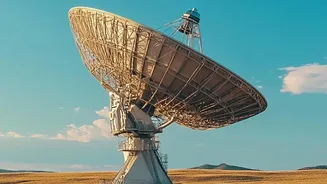
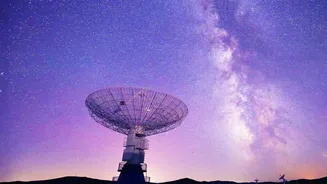
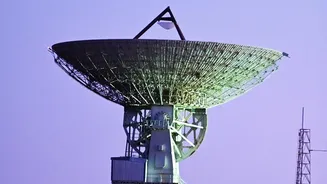
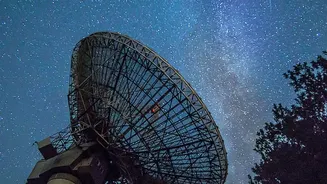
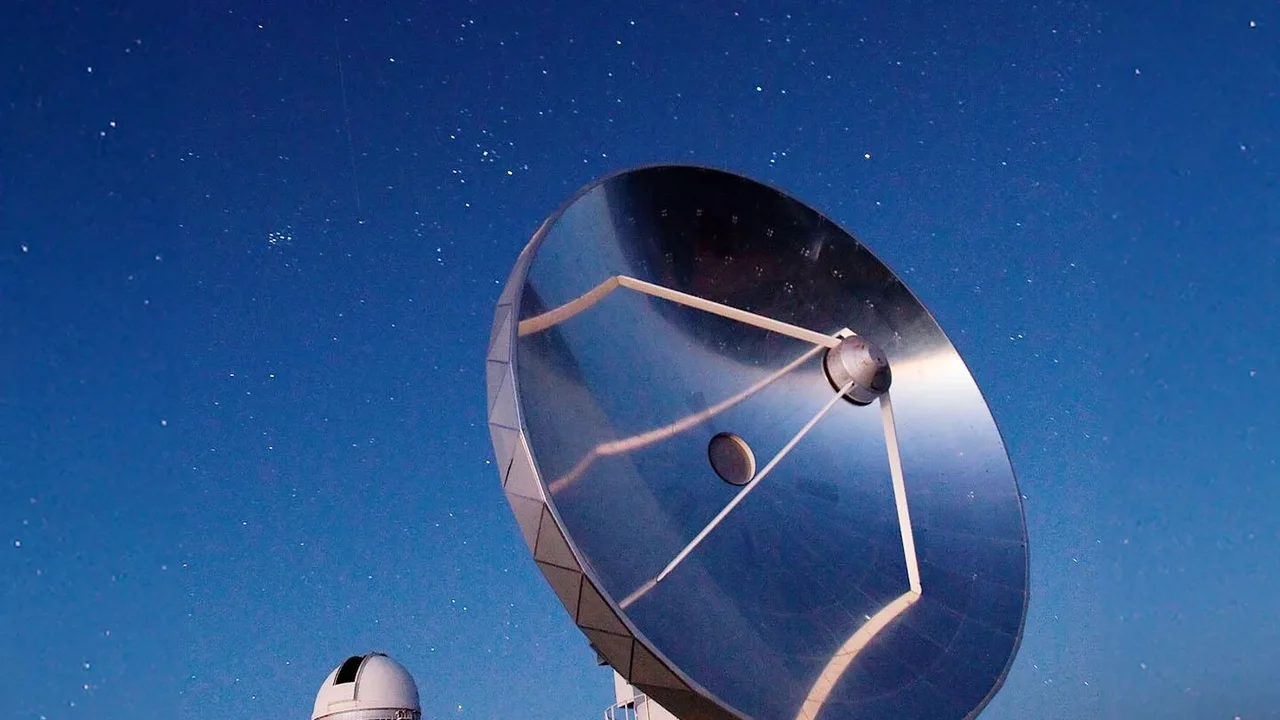
The SKA's two components act like a pair of giant, specialised ears. In South Africa's Karoo region, 'SKA-Mid' will consist of nearly 200 large dish antennas, similar to what most people picture when they think of a radio telescope. These dishes, including the existing 64 from the powerful MeerKAT precursor telescope, will listen for mid-range radio frequencies. Meanwhile, in Western Australia, 'SKA-Low' will be an array of over 131,000 small, Christmas-tree-like antennas. This low-frequency array is designed to pick up the faintest, longest-wavelength signals from deep space. By combining the data from thousands of antennas spread over vast distances, a technique called interferometry, the SKA can simulate a single, gigantic dish with incredible resolution and sensitivity.
Hearing the Cosmic Dawn
The headline's promise of hearing "cosmic origins signals" points to one of the SKA's primary goals: to observe the Epoch of Reionisation. This was a mysterious period in the early universe, a few hundred million years after the Big Bang, when the first stars and galaxies lit up and started ionising the neutral hydrogen gas that filled space. The SKA is designed to detect the faint radio signals emitted by this hydrogen gas from over 13 billion years ago. By mapping these signals, scientists hope to create a 3D picture of how the first large-scale structures in the universe formed, essentially watching the cosmic dawn unfold. It’s like a time machine, allowing us to witness the universe switching on for the first time.
India's Role as the Telescope's 'Brain'
India's involvement in this global project is not just financial; it's central to the telescope's operation. With a contribution of ₹1,250 crore, India is a full member of the SKA Observatory. Critically, a consortium of Indian institutions, led by the National Centre for Radio Astrophysics (NCRA) in Pune, is responsible for designing and delivering the Telescope Manager. This incredibly complex software system is the 'neural system' or 'brain' of the entire observatory. It will be responsible for controlling and monitoring all the telescope components, executing astronomical observations, and ensuring the two vast arrays work in perfect harmony. This places Indian scientists and engineers at the very heart of the SKA's future discoveries.
Beyond Origins: Pulsars and Data Tsunamis
While observing cosmic origins is a headline goal, the SKA's capabilities are vast. It will be an unparalleled tool for testing Einstein's theories of gravity by timing pulsars—the universe's most accurate natural clocks. It will also search for gravitational waves, map cosmic magnetism, and even has the potential to detect signals from extraterrestrial civilisations, if they exist. The sheer volume of data the SKA will generate is staggering, expected to exceed global internet traffic. Managing this data tsunami requires developing new supercomputing technologies and advanced algorithms, driving innovation in a field with enormous commercial and societal benefits. This big data challenge is a project in itself, with India also contributing to the complex data processing solutions.