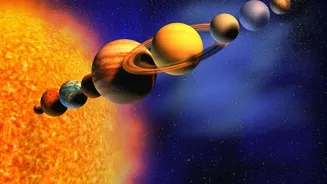


Our Sun feels like a constant, but it has a finite lifespan. In about five billion years, it will begin its dramatic final act. New research is rewriting what we thought we knew about this farewell, suggesting a far more chaotic and uneven end.
The Sun’s Long Goodbye
For the
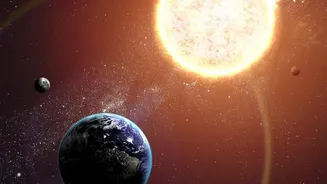
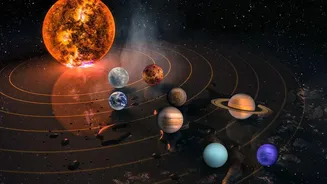
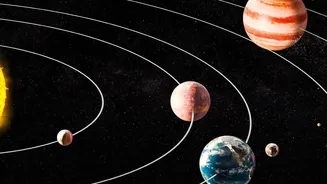
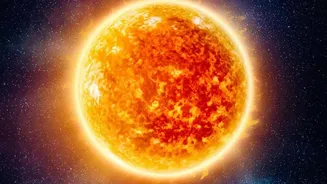
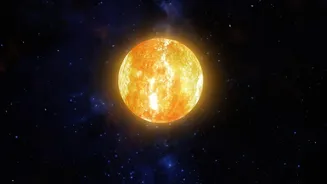
past 4.6 billion years, the Sun has been in its stable main sequence phase, fusing hydrogen into helium in its core. This process provides the energy that sustains life on Earth. But this fuel is finite. Once the hydrogen in its core is exhausted, gravity will cause the core to contract and heat up. This will trigger the fusion of helium and cause the Sun's outer layers to expand dramatically. Our star will swell into a red giant, becoming hundreds of times larger and thousands of times more luminous. In this phase, projected to begin in about five billion years, it will engulf Mercury and Venus, and potentially Earth itself. Even if our planet escapes being swallowed, its oceans will boil away and its atmosphere will be stripped, rendering it lifeless.
A Not-So-Smooth Exit
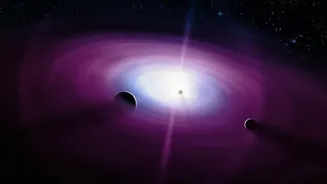
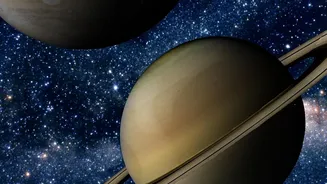
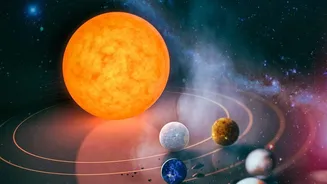
For decades, astronomers believed that after the red giant phase, the Sun would shed its outer layers in a relatively smooth, spherical manner. This process would create a beautiful, glowing shell of gas called a planetary nebula, with the Sun’s dense core—a white dwarf—left behind. This gradual mass loss would weaken the Sun's gravitational pull, causing the remaining outer planets like Jupiter and Saturn to drift into wider, but still stable, orbits. Previous models predicted this new configuration could remain stable for as long as 100 billion years. However, recent research published in The Astrophysical Journal Letters challenges this serene picture entirely, proposing a much more violent and unpredictable process.
Cosmic Kicks and a Chaotic Dance
The new models are based on observations of other dying stars, which show that mass loss is often not smooth but 'stochastic'—meaning it happens in random, violent bursts. Instead of a gentle stellar wind, the Sun will likely eject its mass in thousands of discrete, asymmetric events, almost like giant coronal mass ejections but far more massive. Each of these 'kicks' will push the Sun itself slightly, altering its position and gravitational influence. Over thousands of years, the cumulative effect of these random nudges will introduce a profound element of chaos into the orbits of the giant planets. The stable, predictable clockwork of our outer solar system will begin to unravel.
A New Fate for the Giant Planets
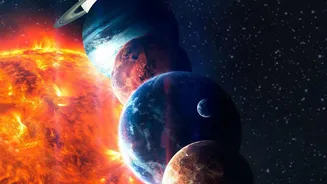
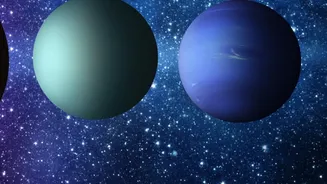
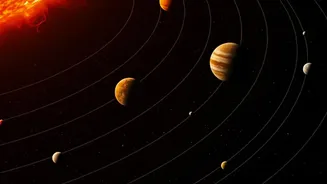
This uneven mass loss paints a grim picture for the solar system’s survivors. The once-stable orbits of Jupiter, Saturn, Uranus, and Neptune will become erratic. Computer simulations based on this new model show that this instability could develop much faster than ever imagined—within just a billion years after the Sun becomes a white dwarf, a hundred times sooner than previous estimates. The results of this chaos are dramatic. In many simulations, planets are thrown into crossing orbits, leading to potential collisions or ejections from the solar system entirely. Saturn might be hurled into interstellar space, while Uranus and Neptune could swap places before being scattered. In about 90% of the simulations, at least one giant planet is lost, destined to become a free-floating 'rogue planet' wandering the galaxy.