



A Glimpse into a Stellar Delivery Room
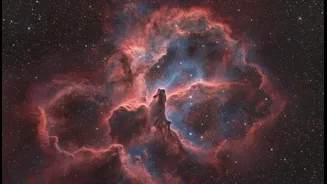
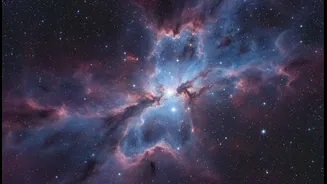
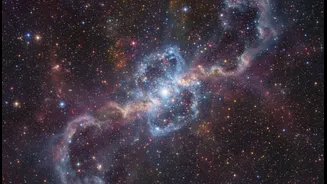
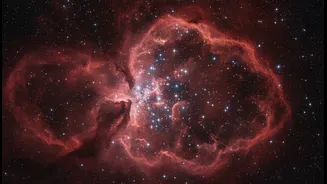
The breathtaking scene unfolds in LH 95, a vast star-forming region located in the Large Magellanic Cloud, a dwarf galaxy that orbits our own Milky Way. This cosmic nursery is a bustling neighborhood containing thousands of developing stars, from small,
infant stars just beginning their journey to massive, brilliant blue giants. Astronomers are fascinated by regions like LH 95 because they offer a relatively clear view into the chaotic and beautiful process of stellar birth. Unlike many star-forming regions within our own galaxy, LH 95 is less obscured by dust, allowing telescopes like the Hubble to peer deep inside.
The Science of the Crimson Glow
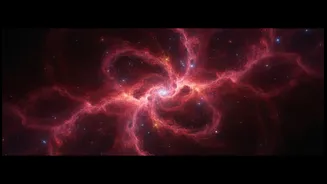
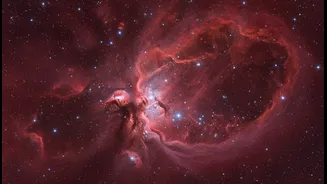
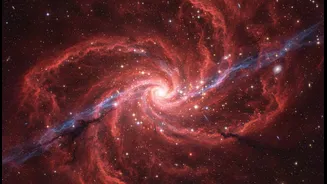
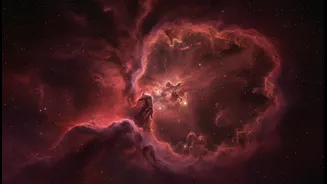
The most striking feature of the image is the vibrant crimson cloud that serves as a backdrop to the sparkling stars. This red hue is not just for artistic effect; it has a specific scientific meaning. The glow comes from what is known as hydrogen-alpha emission. Within these nurseries, massive young stars emit intense ultraviolet radiation. This high-energy radiation excites the surrounding hydrogen gas—the most abundant element in the universe—causing it to glow with a distinct reddish light. For astronomers, this crimson signature is a telltale sign that they are looking at an active area of star formation, helping them pinpoint the very youngest stars embedded within the glowing gas.
Inside the Cosmic Cliffs
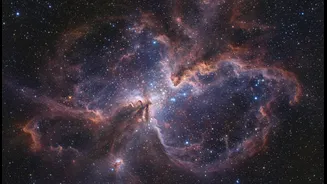
While LH 95 is a recent subject of Hubble's gaze, the imagery is reminiscent of another famous cosmic nursery captured by the James Webb Space Telescope: the 'Cosmic Cliffs' of the Carina Nebula. In both regions, powerful stellar winds and radiation from hot, young stars sculpt the surrounding gas and dust into dramatic pillars and ridges that can be light-years high. These structures are not static; they are constantly being eroded by the fierce energy of the newborn stars. Within these dense towers of gas and dust, the process of star birth continues, largely hidden from view in visible light. Instruments like the Webb telescope, which can see in infrared, are able to pierce through these dusty veils, revealing the protostars and stellar jets shooting out from these nascent suns.
A Story of Stellar Generations
One of the most valuable aspects of studying LH 95 is that it contains multiple generations of stars living side-by-side. This provides a unique cosmic laboratory for understanding how star formation unfolds over millions of years. The observations have revealed about 2,500 young stars that have not yet begun the process of nuclear fusion in their cores—a stage known as 'pre-main-sequence'. These stellar toddlers are still gathering mass from the surrounding disks of gas and dust from which they were born. By studying the rate at which these stars accrete material, scientists can refine their models of stellar development, learning more about how long this important early phase of a star's life can last.
Why These Nurseries Matter
Images of cosmic nurseries do more than just dazzle us with their beauty; they provide crucial insights into the origins of our universe. By observing stars at every stage of their life cycle within a single region, astronomers can piece together a more complete story of stellar evolution. These observations help us understand the processes that formed our own sun and solar system billions of years ago. The intricate dance between the destructive power of massive stars and the creative force of collapsing gas clouds reveals the complex mechanisms that drive the evolution of galaxies. Each new image from observatories like Hubble and Webb builds upon decades of discovery, pushing the boundaries of our knowledge and deepening our connection to the cosmos.