


Cosmic Lighthouses at the Dawn of Time
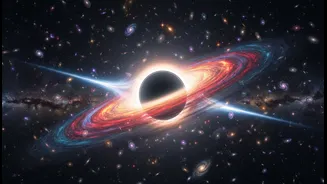
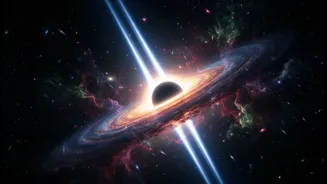
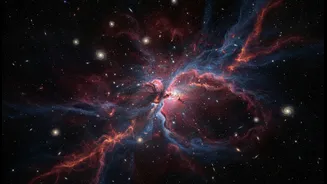
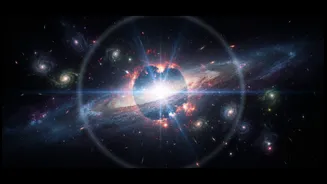
Imagine a lighthouse so powerful it can be seen from billions of light-years away. That's essentially a quasar. Short for "quasi-stellar radio source," these are not stars, but the intensely luminous cores of young galaxies. At the heart of a quasar is
a supermassive black hole, millions or even billions of times the mass of our sun, furiously consuming surrounding gas and dust. As this material spirals into the black hole, it forms a superheated accretion disk, which radiates an incredible amount of energy, often outshining all the stars in its host galaxy combined. This brightness makes them invaluable tools for astronomers, allowing them to peer back into the universe's infancy.
The Standard Story of Cosmic Dawn
The long-held theory of the universe's evolution, often called the Lambda-CDM model, tells a story of gradual growth. After the Big Bang, the universe was filled with a hot, soupy fog of primordial elements — mostly hydrogen and helium. It took hundreds of millions of years for this matter to cool and clump together, thanks to the gravitational pull of dark matter, eventually forming the very first stars. These first stars, known as Population III stars, were thought to be massive and short-lived, and their explosive deaths seeded the cosmos with the first heavy elements (anything heavier than hydrogen and helium). Only then could more complex galaxies, and the supermassive black holes at their centers, begin to form and grow slowly over billions of years.
A Shockingly Early Arrival
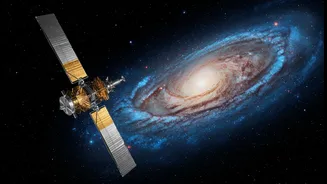
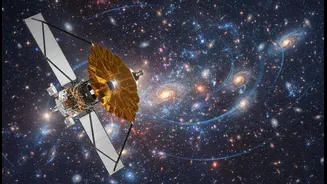
Recent discoveries, however, are throwing a wrench in this tidy timeline. Astronomers using powerful instruments like the Euclid space telescope and the James Webb Space Telescope (JWST) have been finding quasars that are far too massive, far too early. In early July 2026, a team announced the discovery of 31 ancient quasars, including two that are the oldest ever seen. Their light dates back to when the universe was only about 670 million years old—just 5% of its current age. These aren't just small, developing black holes; they are behemoths weighing billions of times the mass of our Sun.
A Universe Ahead of Schedule
The existence of these 'monster' quasars presents a profound puzzle. According to the standard model, there simply shouldn't have been enough time for them to grow so large. Their formation requires immense amounts of matter to fall into a black hole, a process that was believed to be slow and steady. Finding such giants in the cosmic dawn is like finding a fully-grown redwood tree in a tray of just-sprouted seeds. It implies that the processes of galaxy and black hole formation were either much faster or much more efficient than previously thought. Some of these early systems even show surprising amounts of 'heavy' elements like oxygen, which should have taken generations of stars to produce, suggesting they are already chemically mature.
Rewriting the First Chapter
These findings don't break the Big Bang theory itself, but they do force a major revision of its first chapter. Scientists are now scrambling to figure out how these objects grew so massive, so fast. Did the first stars form and die much more rapidly? Were there 'seeds' of black holes that formed directly from the collapse of massive gas clouds in the early universe, bypassing the need for a star first? Other observations have found some of these ancient quasars sitting in surprisingly empty regions of space, challenging the idea that they needed dense clusters of galaxies to feed them. The simple, gradual picture of the early universe is being replaced by one that is more chaotic, rapid, and complex. These ancient quasars, shining from the edge of time, are not just beautiful objects; they are signs that our understanding of our own cosmic origins is still just beginning.