


A Glimpse into the Cosmic Dawn
Imagine looking back in time, not by years or centuries, but by billions of years. This is what the Hubble Space Telescope does for a living. Recently, astronomers have focused on objects from the universe's infancy, a period just a few hundred million
years after the Big Bang. While the headline suggests a single star, recent discoveries have focused on tiny, intensely active galaxies bursting with star formation. One such galaxy, identified as MXDFz4.4, was observed existing a mere 250 million years after the universe began. This is not just a faint smudge of light; it's a window into an era when the cosmos was just beginning to light up, transitioning from a dark, neutral fog to the star-filled expanse we see today.
The Science of Telling Time
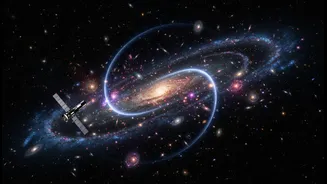
But how can astronomers be sure an object is truly that old? The process is a masterpiece of cosmic detective work. The primary method involves measuring a phenomenon known as 'redshift'. As the universe expands, light from distant objects gets stretched into longer, redder wavelengths. The more distant the object, the more its light is redshifted, giving a reliable measure of its distance and, consequently, its age. For extremely faint and distant objects, astronomers get a helping hand from a trick of gravity predicted by Einstein called 'gravitational lensing'. Massive objects like galaxy clusters in the foreground bend and magnify the light from objects directly behind them, making otherwise invisible ancient stars and galaxies detectable. By analyzing the spectrum of this light, scientists can also determine the chemical composition, confirming the object's primitive nature.
The Universe's First Stars
Theories about the early universe have long predicted the existence of a first generation of stars known as 'Population III' stars. These hypothetical giants were forged only from the primordial elements created in the Big Bang: hydrogen and helium. They would have been extraordinarily massive, hundreds of times the mass of our Sun, and would have burned through their fuel incredibly quickly, living short and dramatic lives before exploding as supernovas. These explosions were crucial, as they seeded the universe with the first heavy elements—the building blocks for all subsequent generations of stars, planets, and even life itself. While we have not directly seen a Population III star, finding their immediate successors or the galaxies they lived in is a key step to confirming these theories.
Connecting the Dots Across Billions of Years
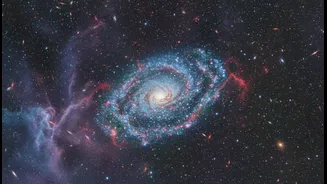
This is where recent Hubble findings become so crucial. Discoveries of extremely early, compact galaxies forming stars at a furious pace provide strong, tangible evidence that supports these models. For instance, the detection of a tiny galaxy like MXDFz4.4, which is 100 times smaller than the Milky Way but forming stars 10 times faster, aligns with theories of rapid, early starbursts. The intense radiation pouring from the young, massive stars within these dwarf galaxies is powerful enough to clear the surrounding hydrogen fog, a process known as reionization, which was a pivotal event in cosmic history. Finding these galaxies in action, with their characteristics matching theoretical predictions, solidifies our understanding of how the universe evolved from its simple beginnings.
More Than Just One Point of Light
While the hunt for a single, definitive first-generation star continues, the discovery of whole populations of ancient galaxies is arguably even more significant. It demonstrates that the early universe was a bustling place, filled with countless small galaxies undergoing intense bursts of star formation. Some observations have even found globular clusters with multiple generations of stars, challenging the simpler idea that all stars in these ancient clusters formed at once and suggesting a more complex, dynamic history. These findings help astronomers refine their computer simulations of galaxy evolution, providing real-world data to test their models against. Each new ancient galaxy found is another critical piece of the puzzle, confirming that our fundamental theories about cosmic origins are on the right track.