




The Case for Young Rings
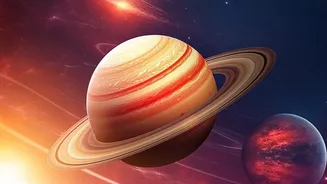
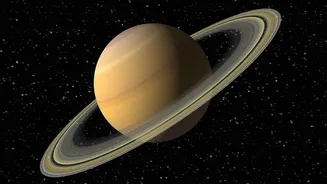
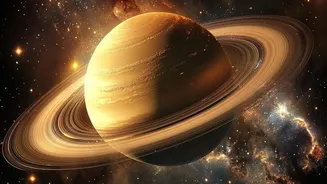
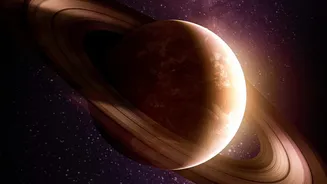
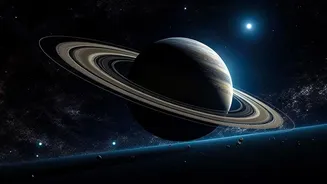
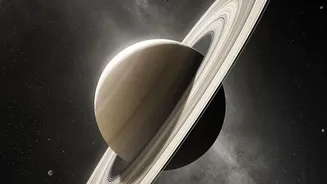
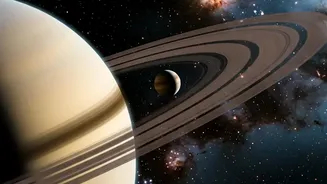
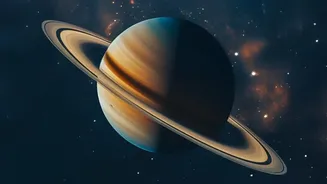
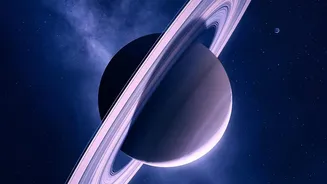
A growing body of evidence, much of it from NASA’s Cassini spacecraft, points to the rings being surprisingly young. The leading theory suggests they may be no more than 100 to 400 million years old. This means they likely formed around the time dinosaurs
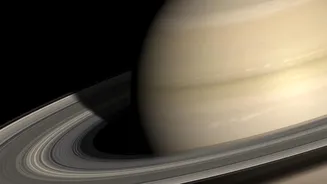
roamed the Earth, long after Saturn itself came into being 4.5 billion years ago. The first major clue is their cleanliness. The rings are made of about 98% pure water ice. For decades, scientists have known that space is not empty; it’s filled with a constant shower of micrometeoroids—tiny grains of rocky dust. If the rings were billions of years old, they should be much darker and more “polluted” by this dust. Their bright, icy nature suggests they simply haven't been around long enough to get dirty.
Cassini's Grand Finale
The most compelling data came from the final phase of the Cassini mission in 2017. In a series of daring dives, the spacecraft flew between Saturn and its rings, allowing scientists to measure the rings' mass for the first time by feeling their gravitational pull. The results were surprising: the rings are relatively lightweight, with a total mass only about half that of Saturn's moon Mimas. Lower mass points to a younger age. The logic is that an older, more massive ring system would have been darkened by billions of years of cosmic dust bombardment. These direct measurements bolstered the theory that the rings are a relatively recent addition, possibly formed when one of Saturn’s icy moons or a passing comet was torn apart by the planet’s immense gravity.
The 'Ring Rain' Phenomenon
Adding to the mystery is the discovery that the rings are actively disappearing. Scientists have observed what they call "ring rain"—a process where ice particles from the rings are pulled in by Saturn's gravity and magnetic field, essentially raining down onto the planet. The rate of this loss is astonishing; some estimates suggest an amount of water equivalent to an Olympic-sized swimming pool drains from the rings every half hour. At this rate, the entire ring system could be gone in as little as 100 million years. This rapid erosion suggests we are coincidentally living in a brief cosmic window when Saturn has its magnificent rings. If they are disappearing so fast, it stands to reason they haven't been around for very long.
The Argument for Ancient Rings
Despite the strong evidence for young rings, the debate is far from over. For most of the 20th century, the prevailing assumption was that the rings formed at the same time as Saturn. Some scientists still argue this is the case, suggesting that there are processes at play that make the old rings merely look young. One theory proposes that the rings are much more massive than they appear and are constantly recycling material, churning brighter ice from the interior to the surface. This would keep them looking fresh despite their age. Other recent computer models suggest that the polluting effect of micrometeoroids might have been overestimated. Instead of simply dirtying the ice, these high-velocity impacts could vaporize material and eject the resulting charged particles, effectively cleaning the rings and making age estimates based on purity unreliable.
An Unsolved Cosmic Mystery
So why can't scientists agree? The core of the problem is that we cannot directly measure age. Instead, researchers must rely on models and inferences based on properties like mass, brightness, and the rate of dust accumulation. Different assumptions about these factors lead to vastly different conclusions. The "young ring" theory is heavily supported by Cassini's direct measurements of mass and dust influx. The "old ring" theory relies more on models suggesting the rings could be self-cleaning or that the initial formation event was more likely to have happened in the chaotic early solar system. Without another mission to Saturn to gather more data, particularly on the complex ways ring particles interact, the debate is likely to continue.