



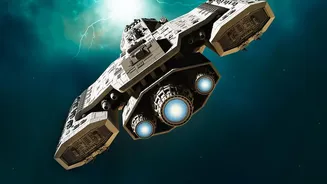
Meet 'Pushpak,' India's Space Shuttle
The vehicle at the heart of these tests is the Reusable Launch Vehicle - Technology Demonstrator (RLV-TD), affectionately named 'Pushpak'. This uncrewed, winged craft is India's ambitious step towards creating a fully reusable two-stage-to-orbit launch
vehicle. Unlike conventional rockets that are discarded after a single use, Pushpak is designed to fly back to Earth and land on a runway, just like an airplane. The name itself is a nod to the mythological flying palace from the Ramayana, signifying India's blend of ancient heritage and modern technological aspirations. This scaled-down prototype is a flying testbed for a host of technologies ISRO needs to master, from hypersonic flight to autonomous landing.
A 'Hat-Trick' of Perfect Landings
The most recent trials have focused on one of the most critical phases of a reusable vehicle's mission: landing. In a series of three landing experiments (LEX), ISRO has now perfected the autonomous touchdown of Pushpak. During the latest test at the Aeronautical Test Range in Chitradurga, the vehicle was carried to an altitude of 4.5 km by an Indian Air Force Chinook helicopter and released. From there, Pushpak’s onboard computers took complete control. It navigated itself towards the runway, corrected its course against challenging winds, and executed a flawless, high-speed horizontal landing at 350 kmph before deploying a brake parachute to stop. Successfully repeating this feat proves ISRO has mastered the complex autonomous systems required for a safe return.
Why Reusability Is a Game-Changer
Imagine buying a new car for every single road trip you take. That’s essentially how traditional space launches work. The rocket, which is the most expensive part of any mission, is used once and then falls into the ocean. This makes accessing space incredibly expensive. Reusability completely changes this economic model. By designing launch vehicles whose most expensive stages can return to Earth, be refurbished, and fly again, the massive manufacturing cost is spread over multiple missions. The only significant recurring costs become fuel and ground operations, which are a fraction of the hardware cost. This is the core principle that has allowed private companies to drastically lower launch prices globally.
Slashing the Cost to Orbit
The primary goal of the RLV program is to dramatically cut the cost of sending satellites into orbit. ISRO's aim is to bring down the launch cost by a significant margin, potentially by as much as 80 percent. By recovering and reusing the first stage of its launch vehicle, ISRO can make its launch services far more competitive on the global market. This not only makes India a more attractive destination for international satellite companies but also empowers domestic startups and academic institutions to launch their own missions without prohibitive costs. Cheaper access to space means more satellites for communication, earth observation, and scientific research can be deployed, accelerating innovation and development across various sectors.
The Road Ahead for RLV
The successful landing experiments are a major milestone, but they are just one part of a phased technology demonstration program. Having proven its hypersonic flight capabilities in an earlier test (HEX) and now its autonomous landing (LEX), ISRO's next major step is the Orbital Re-entry Experiment (ORE). This will involve launching a scaled-up version of Pushpak into orbit on a conventional rocket. After staying in orbit for a period, the vehicle will de-orbit, survive the intense heat of re-entry into the atmosphere, and perform an autonomous landing on a runway. Mastering this final, most challenging phase will pave the way for India’s first fully operational two-stage reusable launch vehicle, a system that could define the next era of India's space journey.