





Listening to Cosmic Clocks
The key to this monumental effort lies with pulsars, some of the most exotic and reliable objects in the universe. A pulsar is the tiny, super-dense remnant of a massive star that has gone supernova. Spinning hundreds of times per second, it sweeps a beam
of radio waves across space, much like a lighthouse. From our perspective on Earth, this creates a pulse of radio energy that arrives with a regularity so precise it rivals atomic clocks. This incredible stability makes pulsars perfect celestial timekeepers. Scientists at projects like the North American Nanohertz Observatory for Gravitational Waves (NANOGrav) use an array of these pulsars spread across our galaxy, timing the arrival of their pulses to within nanoseconds.
The Hunt for a 'Hum'
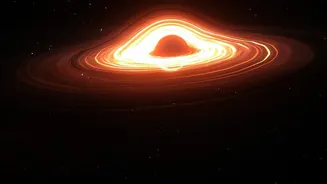
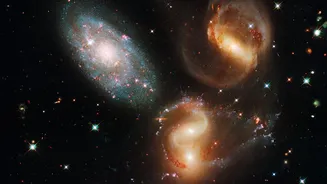
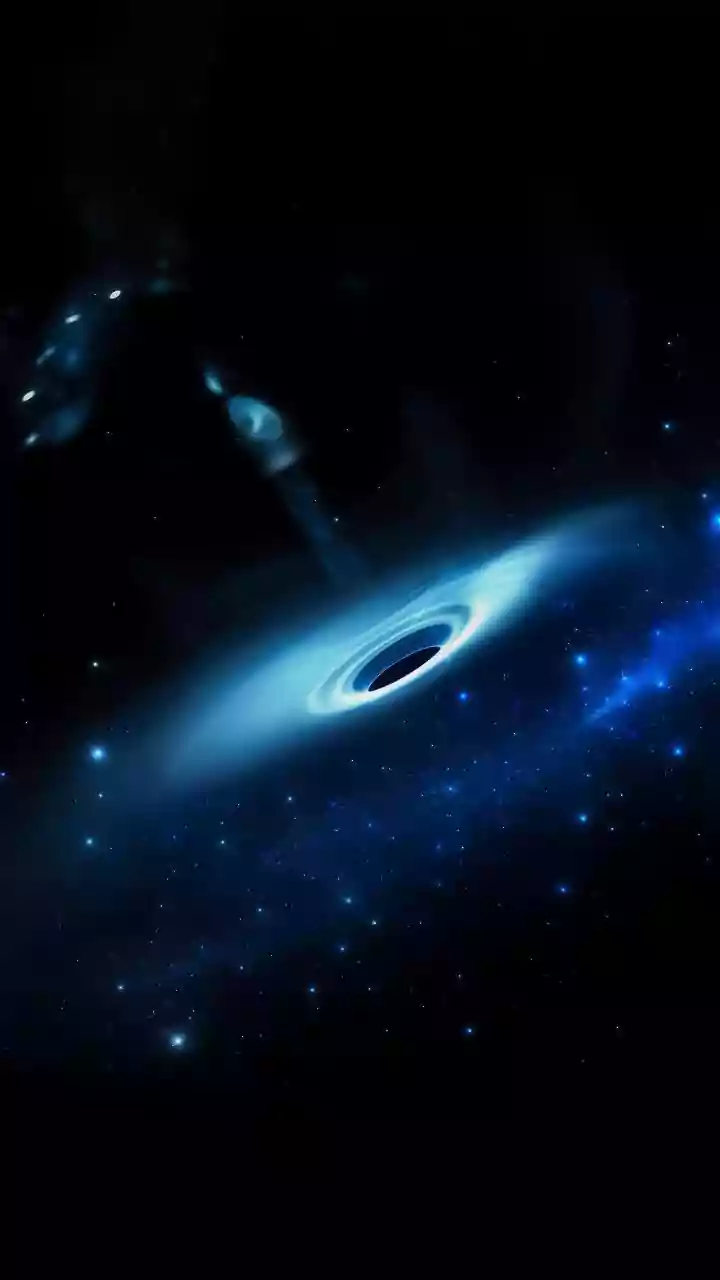
What are they listening for? Not the dramatic 'chirps' of two black holes colliding that detectors like LIGO have famously captured. Instead, they are searching for a much subtler signal: the gravitational wave background (GWB). This is a persistent, low-frequency hum that permeates the entire universe, believed to be the combined murmur of countless pairs of supermassive black holes, each millions or billions of times the mass of our sun, slowly spiraling toward each other at the hearts of distant galaxies. This background is a fundamental prediction of our models of galaxy formation and evolution. Detecting it would be a landmark achievement, confirming that these colossal mergers are a common cosmic occurrence.
Why a Decade is the Minimum
This is where the need for patience becomes critical. The gravitational waves that form this background have incredibly long wavelengths, meaning their oscillations take years, or even decades, to complete one cycle. Trying to detect such a wave with only a year or two of data would be like trying to measure the ocean tide by watching a buoy for just a few seconds; you would see random bobbing but miss the slow, underlying rise and fall. To detect a wave, you must observe for a significant fraction of its period. A dataset spanning ten to fifteen years is the minimum required to see the tell-tale pattern emerge from the noise. This pattern, predicted by Einstein's theory of general relativity, is a specific, correlated stretching and squeezing of spacetime that causes pulses from some pulsars to arrive slightly early while others arrive slightly late.
A Planet-Sized Observatory
By using dozens of pulsars, astronomers have effectively created a gravitational wave detector the size of a galaxy. This 'Pulsar Timing Array' or PTA isn't a single machine, but a collaborative effort between multiple radio telescopes around the world, including the Parkes Pulsar Timing Array (PPTA) in Australia and the European Pulsar Timing Array (EPTA). When a gravitational wave passes between Earth and a pulsar, it alters the fabric of spacetime, changing the path length the radio pulse has to travel. By comparing the timing shifts across many pulsars in different parts of the sky, scientists can filter out noise and confirm that the variations are caused by a common, galaxy-spanning signal, confirming the signature of gravitational waves.
Beyond Einstein's Predictions
The payoff for this decade-long watch is immense. Successfully measuring the gravitational wave background provides another stunning confirmation of Einstein's theory of general relativity in a new, low-frequency regime. But even more exciting is the possibility of finding something unexpected. If the signal deviates from the predictions, it could point to new, undiscovered physics. For example, the properties of the background hum could hold clues about exotic phenomena from the very early universe, such as cosmic strings or phase transitions that occurred moments after the Big Bang. These long-term observations are not just about confirming what we know, but about opening a brand-new window to probe the universe's most fundamental secrets.