
A Universe of Big Data
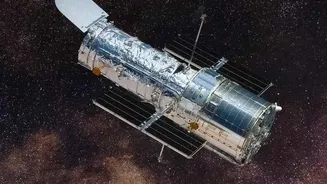
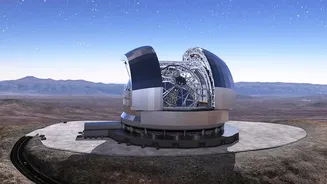
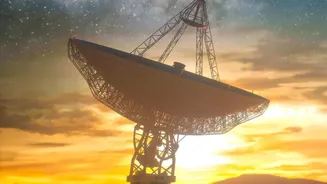
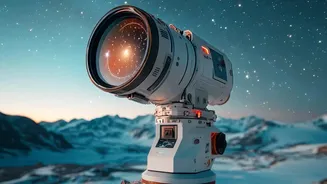
Astronomy has entered the era of big data. Telescopes like NASA's Hubble, the James Webb Space Telescope, and ground-based observatories scan the sky, collecting staggering amounts of information. For example, the Vera C. Rubin Observatory in Chile is
expected to photograph the entire southern sky every few nights, generating about 10 terabytes of data daily. Over its ten-year mission, it will create a 500-petabyte dataset. To put that in perspective, a single petabyte is a million gigabytes. This flood of images contains clues about everything from dark matter to the formation of our Milky Way. However, the sheer volume makes manual analysis impossible. It would take an astronomer years to sift through what a telescope can gather in a single night.
Training the Digital Astronomer
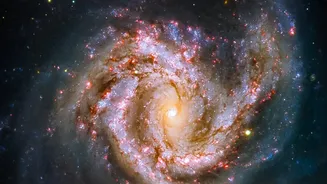
This is where machine learning (ML), a type of artificial intelligence, becomes an essential partner in discovery. Instead of being explicitly programmed for a task, ML algorithms learn from data. Astronomers 'train' these systems by feeding them vast, labeled datasets. For instance, to teach an AI to identify galaxies, researchers provide it with thousands of images that have already been classified by humans. The algorithm, often a neural network, learns to recognize the tell-tale patterns, shapes, and properties associated with different types of galaxies. Over time, it gets better at the task, eventually learning to classify new, unseen images with incredible speed and accuracy. This frees up human astronomers from tedious classification work to focus on more creative and interpretative tasks.
From Galaxies to Gravitational Lenses
The applications of machine learning in astronomy are already transforming the field. AI systems are now routinely used to classify galaxies, helping us understand their evolution. One deep learning system, ClaRAN, was specifically developed to spot radio galaxies, which have powerful jets extending from the supermassive black holes at their centers. Other algorithms are trained to find exoplanets by detecting the tiny, regular dips in a star's brightness caused by a planet passing in front of it. Machine learning has also proven highly effective at identifying rare and valuable phenomena like gravitational lenses—where a massive galaxy bends the light of a more distant object, magnifying it. These lenses are crucial for mapping dark matter, but are incredibly hard to spot. By automating the search, ML helps find more of these cosmic magnifying glasses.
Detecting the Unexpected
Beyond simple classification, machine learning is also adept at finding anomalies—the weird and wonderful things that don't fit known patterns. These outliers are often the most exciting targets for new discoveries. By sifting through billions of observations, AI can flag unusual signals or transient events, like an exploding star or a fast-moving asteroid, that a human might have missed. A recent breakthrough showed that a general-purpose large language model could be taught to spot real cosmic events with high accuracy using just a handful of examples and simple instructions. This not only accelerates discovery but also makes the tools more accessible to scientists who aren't AI programming experts.
The Future is a Human-Machine Partnership
The integration of machine learning isn't about replacing human astronomers, but augmenting their abilities. While an algorithm can process data at superhuman speeds, it still lacks the ability to explain the underlying physics of why something is interesting. The future of astronomy lies in a collaborative partnership. AI can do the heavy lifting of sifting, sorting, and flagging, while human experts provide the crucial context, interpretation, and scientific curiosity. As new facilities like the Vera C. Rubin Observatory come online, this partnership will become even more critical, pushing the boundaries of what we know about our universe and enabling discoveries we can't yet imagine.