






The Old Way: Simulating the Atmosphere
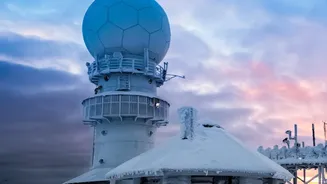
Traditional weather forecasting, known as Numerical Weather Prediction (NWP), is a monumental task. It involves using supercomputers to solve complex physical equations that govern the movement of the atmosphere. These models divide the globe into a grid
and calculate variables like temperature, pressure, and wind for each grid point. While incredibly powerful, this method is also incredibly slow and computationally expensive. Running a single, high-resolution 10-day forecast can take a supercomputer several hours. This time lag and high cost limit how many forecasts can be run and how frequently they can be updated, creating a natural ceiling for accuracy and speed.
A New Approach: Learning from the Past
Artificial intelligence models take a completely different approach. Instead of solving physics equations from scratch, they are trained on decades of historical weather data. AI systems like Google's GraphCast, NVIDIA's FourCastNet, and Huawei's Pangu-Weather learn the complex patterns and relationships between different weather states from this vast archive. Essentially, they learn what atmospheric conditions tend to lead to specific outcomes by analysing the past. This data-driven method allows them to make predictions by recognizing patterns in the current weather and projecting them forward, a process that is dramatically faster than traditional simulation.
The Speed and Accuracy Advantage
The results have been stunning. AI models are not only faster, but they are also proving to be more accurate in many scenarios. Google's GraphCast, for instance, can produce a 10-day global forecast in under a minute on a single machine. In head-to-head comparisons, it outperformed the leading European NWP model on over 90% of variables. Similarly, NVIDIA's FourCastNet can generate a 15-day forecast in just over a minute. This incredible speed allows forecasters to run a massive number of scenarios, or 'ensembles', which helps to better quantify uncertainty and increase the warning time for extreme weather events.
The Indian Context: Predicting the Monsoon
These advancements have significant implications for India, where predicting the monsoon is critical for agriculture and the economy. In 2026, the India Meteorological Department (IMD) launched the country's first AI-based system to predict the monsoon's onset at a local level up to four weeks in advance. Last year, a project involving the University of Chicago and Google's NeuralGCM model provided AI-powered forecasts to 38 million farmers across India. The models successfully predicted the monsoon's arrival, even capturing an unusual dry spell, allowing farmers to make better-informed decisions about when to plant their crops.
Not a Magic Bullet: The Hurdles for AI
Despite their promise, AI models are not without weaknesses. Their biggest limitation is that they are only as good as the data they are trained on. This means they can struggle to predict unprecedented events or extreme weather patterns that fall outside their historical training data. Some studies have found that while AI excels at general forecasting, traditional physics-based models may still perform better for record-breaking extreme events. Furthermore, many AI models operate as 'black boxes', making it difficult for meteorologists to understand exactly why a model made a particular prediction, a challenge for building trust and ensuring reliability.