





Creating the Fifth State of Matter
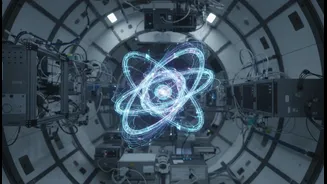
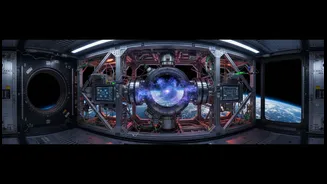
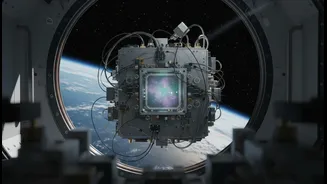
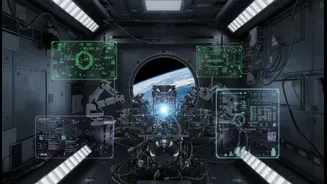
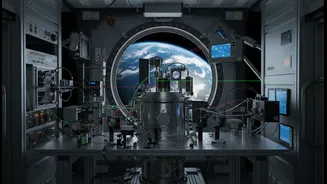
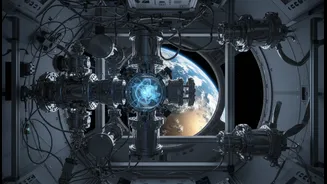
The primary mission of the Cold Atom Lab is to create and study a bizarre state of matter called a Bose-Einstein condensate (BEC). First predicted by Satyendra Nath Bose and Albert Einstein, and created in a lab in 1995, a BEC is considered the fifth
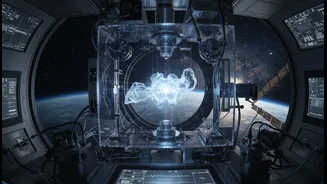
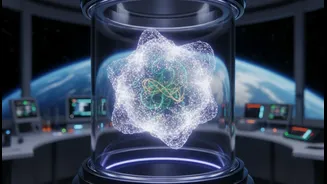
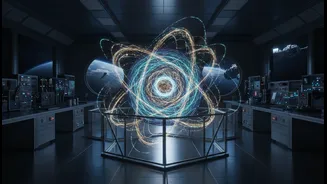
state of matter after solids, liquids, gases, and plasmas. To create one, scientists use a sophisticated system of lasers and magnetic fields to cool a cloud of atoms, like rubidium or potassium, to temperatures just a fraction of a degree above absolute zero—the theoretical point where all atomic motion ceases. At these extreme temperatures, colder than any naturally occurring place in the cosmos, the atoms slow down so much that their quantum properties take over. They stop behaving like individual particles and start acting like a single, collective 'super-atom' or matter wave.
Why Microgravity is the Perfect Laboratory
While scientists can create BECs on Earth, gravity poses a significant problem. The atomic cloud is quickly pulled downward, limiting observation times to mere fractions of a second. On the International Space Station, the persistent freefall of microgravity changes everything. Without gravity's relentless tug, scientists can observe these condensates for much longer periods—up to 10 seconds or more. This extended observation time allows for colder temperatures and more precise measurements than are possible on the ground. The microgravity environment allows the delicate, wave-like nature of the atoms to be studied in a much cleaner setting, opening up new avenues for fundamental research into quantum mechanics.
A New Frontier in Navigation
One of the most promising applications of this research is in the field of quantum navigation. Current GPS and satellite navigation systems are essential but vulnerable to signal loss or jamming. An alternative is inertial navigation, which uses accelerometers and gyroscopes to track motion without external signals. However, classical inertial systems suffer from drift over time, accumulating errors. Quantum sensors, specifically atom interferometers, offer a solution. By using the wave-like properties of cold atoms, these devices can measure acceleration and rotation with extraordinary precision. Because every atom of an element is identical and its properties are set by fundamental constants, these sensors do not drift. The Cold Atom Lab serves as a crucial testbed for developing this technology, proving that these sensitive instruments can operate reliably in space and one day guide spacecraft or submarines without needing a satellite signal.
Testing the Fundamentals of Gravity
Beyond technological applications, the Cold Atom Lab is a powerful tool for probing the fundamental laws of physics. The extreme sensitivity of atom interferometers makes them ideal for testing Einstein's theory of general relativity, including the equivalence principle, with unprecedented accuracy. By precisely tracking how the matter waves of different atoms fall in microgravity, scientists can search for tiny deviations that might point to new physics. These experiments could help refine our understanding of gravity and even hunt for elusive phenomena like dark matter and gravitational waves from the early universe. The ability to create and manipulate these ultracold quantum gases in space allows for entirely new kinds of experiments that could unlock some of the deepest secrets of the cosmos.