






After a hunt spanning more than four decades, scientists at CERN have captured evidence of one of the rarest particle decays ever witnessed. This incredible feat of precision opens a new window into the subatomic world, testing our most fundamental theories.
The Forty-Year Hunt for a Ghostly Decay
Imagine searching for one specific grain of sand on all the beaches of the world. That's the scale of the challenge physicists at CERN's Large Hadron Collider (LHC) just overcame. They found the first evidence for an extremely rare process: a particle known as a 'beauty' meson, or B0 meson, decaying into two smaller particles called muons. This event is so infrequent it is predicted to happen only once in every ten billion decays of a beauty particle. The search began back in 1984, long before many of the scientists currently working on the project were even born. For decades, experiments could only set limits on how often it might occur, but they could never definitively spot it. Now, the LHCb experiment at CERN has seen a signal strong enough to be called 'evidence', a major milestone in particle physics.
What is the Standard Model and Why Test It?
This discovery is a crucial test of the Standard Model of particle physics. Think of the Standard Model as the 'rulebook' for the universe's fundamental building blocks. Developed over the last half-century, it describes the family of particles like quarks and leptons that make up all matter, and the forces that govern how they interact. While incredibly successful, the model is incomplete; it doesn't explain gravity, dark matter, or why matter exists at all. Extremely rare decays like this one are highly sensitive to the influence of new, undiscovered particles or forces. If the measured rate of this decay differed from the Standard Model's prediction, it would be a clear sign of 'new physics'. The recent results, however, align closely with the theory, which, while not as dramatic as finding a flaw, is still hugely important. It helps scientists narrow down where these new particles could be hiding.
The Tech Behind the Triumph
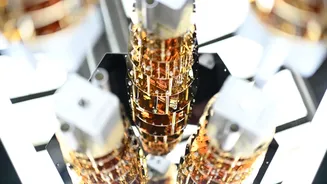
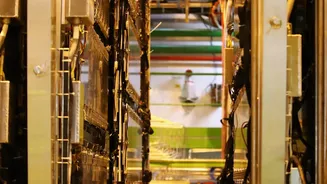
Observing such a rare event requires extraordinary technology. The breakthrough was made possible by a major upgrade to the LHCb experiment, one of the four large detectors on the LHC ring. This upgrade allows the detector to record particle collisions at up to five times its previous rate, providing a mountain of data to sift through. At the heart of this is a sophisticated silicon detector called the Vertex Locator (VELO), which sits just millimetres from the particle beam and can track the paths of particles with pinpoint accuracy. Combined with powerful machine learning algorithms to filter out background 'noise', scientists were able to isolate the faint signal of the B0 meson decay from trillions of other particle interactions.
India's Crucial Role at CERN
This global scientific endeavour has a significant Indian footprint. India became an Associate Member of CERN in 2017, but its collaboration dates back decades. Indian institutions like the Bhabha Atomic Research Centre (BARC) and the Tata Institute of Fundamental Research (TIFR) have been instrumental. For the LHC accelerator itself, India supplied thousands of critical components, including over 7,000 precision magnet positioning jacks and superconducting corrector magnets essential for steering the particle beams. Indian scientists have also been key players in the major experiments, including CMS and ALICE. Furthermore, Tier-2 computing centres in Mumbai and Kolkata are part of the Worldwide LHC Computing Grid, providing the immense computational power needed to analyse the petabytes of data these experiments produce.
Knocking on the Door of the 'Zeptoverse'
While this result doesn't break the Standard Model, it ushers in a new era of precision measurement. Scientists describe this as entering the 'zeptoverse'—a realm of unbelievably small distances, a billionth of a trillionth of a metre across. At these scales, new and unknown forces may be hiding. By confirming that even this ultra_rare decay behaves as predicted, physicists can refine their theories and better guide the search for what lies beyond our current understanding. The LHCb collaboration will continue collecting data, hoping to increase the statistical significance of this evidence to the 'five_sigma' gold standard required to claim a formal 'discovery'. Each new measurement sharpens our view of the universe's fundamental rules.