



A Boost From The Red Planet
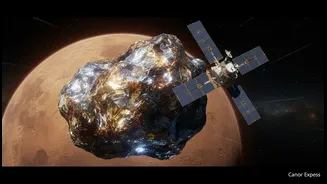
NASA's Psyche spacecraft has a long journey ahead. Launched in October 2023, its ultimate destination is a unique metal-rich asteroid, also named Psyche, located in the main asteroid belt between Mars and Jupiter. To get there efficiently, the mission
planned a critical manoeuvre: a gravity-assist flyby of Mars. This technique uses a planet's gravitational pull to 'slingshot' a spacecraft, increasing its speed and adjusting its trajectory without using precious onboard fuel. On May 15, 2026, Psyche executed this flyby, skimming just 4,500 to 4,600 kilometres above the Martian surface. The manoeuvre was a success, but it also presented a valuable scientific opportunity that mission planners were keen to exploit.
An Opportunity for a Check-Up
A planetary flyby is the perfect time to test and calibrate a spacecraft's sensitive instruments before it reaches its primary target. The Psyche mission team wanted to ensure its multispectral imager and other sensors were working perfectly for their 2029 arrival at the asteroid. By pointing its cameras at a well-documented subject like Mars, scientists can fine-tune their equipment. This is where the idea for a collaboration was born. Upon hearing of Psyche's planned flyby, the team managing the European Space Agency's (ESA) long-running Mars Express mission saw a chance to help.
A Veteran Lends Its Eye
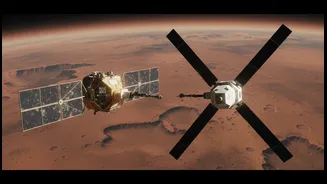
In orbit around Mars since 2003, ESA's Mars Express is one of the most seasoned explorers of the Red Planet. Its instruments, like the High Resolution Stereo Camera (HRSC), are well-understood. Weeks in advance, teams from NASA and ESA exchanged detailed trajectory data and observation timelines. The goal was for both Psyche and Mars Express to capture images of the same Martian landscapes at almost the same time. They successfully imaged regions like Noachis Terra, one of the oldest parts of Mars. Although the images were taken just under two hours apart, the spacecraft had vastly different perspectives. Mars Express was orbiting at an altitude of about 6,000 km, while the departing Psyche was already 41,000 km away.
The Value of a Second Opinion
This coordinated observation was more than just a photo opportunity. By comparing the images from Psyche's new camera with the reliable data from Mars Express's veteran camera, scientists can perform a crucial calibration. They can check for small differences in how each camera responds to light, colour, and brightness. This ensures that when Psyche finally begins its scientific investigation of its target asteroid, the data it sends back will be as accurate as possible. This collaboration provides a baseline, a known reference point millions of kilometres from home, significantly reducing uncertainty for the mission's primary objective. The assistance from Mars Express, along with other orbiters, provides a valuable service that enhances the quality and reliability of a multi-billion dollar mission.
A Blueprint for Future Exploration
This instance of inter-agency support is a powerful example of a growing trend in space exploration. Ambitious undertakings like the International Space Station (ISS) and the Artemis program have already proven that international cooperation is not just beneficial, but essential for success. The ISS, a collaboration between five major space agencies, has been a hub of scientific discovery for over two decades. By sharing resources, knowledge, and even spacecraft tracking capabilities, agencies can mitigate risks, save costs, and achieve more than they could alone. The handshake between Mars Express and Psyche demonstrates this principle on an interplanetary scale, creating a model for how future missions to Mars and beyond can support each other, ensuring higher chances of success as humanity ventures further into the cosmos.