
Our Star's Turbulent Temper
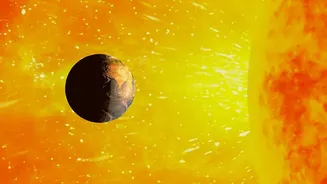
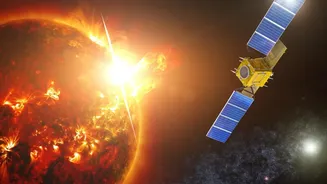
The sun's surface is a chaotic place of tangled magnetic fields. Sometimes, these fields snap and reconnect, causing a solar flare—a sudden, intense flash of radiation. Other times, the sun ejects a massive bubble of magnetised plasma and gas called a coronal
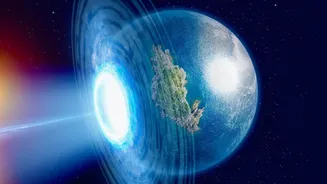
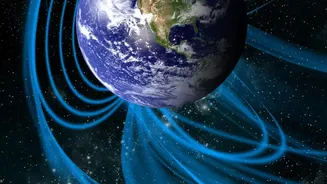
mass ejection, or CME. While a flare's radiation reaches Earth in about eight minutes, a CME is a slower-moving cloud of matter that can take several days to cross the 93 million miles to our planet. When a CME slams into Earth’s magnetic field, it can trigger a geomagnetic storm, which is where the real trouble for our technology begins.
Danger in Orbit and the Skies
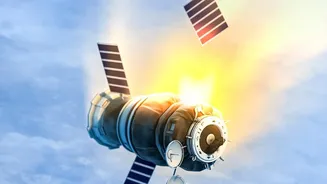
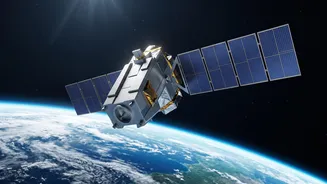
Satellites are our first line of defense, but also the most vulnerable. Beyond the protection of Earth's atmosphere, they are directly exposed to energetic particles from solar events. These particles can damage solar panels, confuse electronic systems, and even cause 'phantom commands' that disrupt a satellite's function. During intense storms, the upper atmosphere heats and expands, increasing drag on satellites in low-Earth orbit, which can alter their trajectory and even cause them to fall out of orbit. This has a direct impact on services we rely on daily, from GPS navigation—which can suffer accuracy errors or complete signal loss—to television broadcasting and weather forecasting. High-frequency radio communication, crucial for aviation and military operations, can also be blacked out.
The Threat to the Grid on the Ground
A severe geomagnetic storm poses a significant threat to our terrestrial power grids. These storms create powerful geomagnetically induced currents (GICs) that flow through the ground and can find their way into long conductors like power lines. These currents can surge into high-voltage transformers, causing them to overheat, saturate, and, in worst-case scenarios, fail completely. This isn't just a theoretical problem. In March 1989, a solar storm caused the entire power grid of Quebec, Canada, to collapse, leaving millions in the dark. A damaged transformer can take months or even years to replace, meaning a widespread outage could have long-lasting consequences for everything from transportation and finance to basic home services.
A Warning from History: The Carrington Event
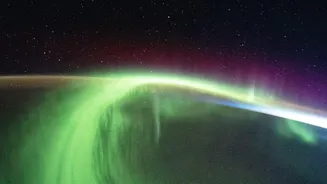
The benchmark for a worst-case scenario is the Carrington Event of 1859. Named after British astronomer Richard Carrington, who was the first to observe the preceding solar flare, this was the most intense geomagnetic storm in recorded history. The CME reached Earth in a record 17.6 hours. It was so powerful that auroras were seen as far south as Cuba and Hawaii, and people in the northeastern United States could reportedly read newspapers at night by the auroral light. The fledgling telegraph technology of the era was thrown into chaos; operators received electric shocks, and telegraph paper reportedly caught fire. If an event of this magnitude were to happen today, the impact on our far more complex and interconnected technological society would be catastrophic.
Predicting and Preparing for Solar Fury
We cannot stop solar storms, but we can prepare for them. Scientists and agencies like NOAA's Space Weather Prediction Center constantly monitor the sun for threatening activity. This gives satellite operators, airlines, and power grid managers crucial warning time—from hours to days—to take protective measures. These can include temporarily shutting down sensitive satellite components, rerouting flights away from polar regions where effects are strongest, or even proactively de-energizing parts of the power grid to prevent widespread damage. Furthermore, new technologies and hardware, like neutral blocking devices, are being developed and installed to help shield vulnerable transformers from geomagnetically induced currents, making the grid more resilient.