



A Sweet Discovery in Deep Space
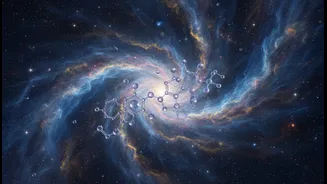
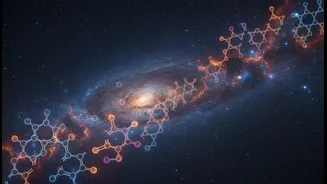
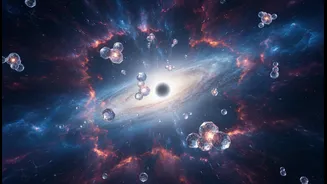
Astronomers have detected a sugar molecule known as erythrulose floating in a giant cloud of dust and gas near the heart of the Milky Way. This discovery, made using powerful radio telescopes in Spain, is the first time a “true sugar” has been identified
in the interstellar medium—the vast space between stars. The molecule was found in a chemically rich region called G+0.693-0.027, a stellar nursery where new stars and planets are born. While scientists have previously found sugar-like molecules in meteorites that have landed on Earth, this detection confirms that such complex organic compounds can form naturally in the harsh, frigid conditions of deep space, even before planets exist.
More Than Just a Grain of Sugar
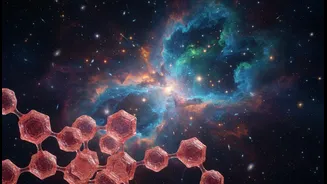
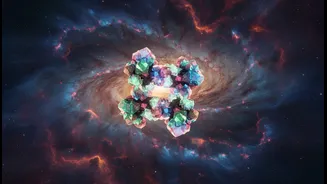
So, what exactly is erythrulose? It is a four-carbon sugar, similar to the type found in raspberries. While you won’t be sweetening your tea with it, its chemical structure is incredibly significant. Sugars form the backbone of life’s most critical molecules. For example, ribose sugar is a key component of RNA, a molecule essential for carrying genetic instructions in all known life. Scientists believe that erythrulose is a crucial precursor to these more complex molecules. In the presence of water, it can readily change into other sugars that are implicated in the formation of ribonucleotides, the building blocks of RNA. Its presence in space suggests a plausible pathway for how the raw materials for life could have been created.
The Cosmic Chemical Factory
The discovery provides a fascinating glimpse into the universe's capacity for complex chemistry. The giant molecular clouds near the galactic centre act as colossal chemical factories. Temperatures can be close to absolute zero, but over millions of years, simple atoms and molecules stick to the surfaces of icy dust grains. Here, they combine to form more complex structures, a process known as grain-surface chemistry. Researchers believe erythrulose forms when two smaller molecules, glycolaldehyde and ethylene glycol, which are known to be abundant in these regions, combine on these icy surfaces. This finding confirms that the journey towards biological complexity doesn't start on planets, but much earlier, in the cosmic clouds from which stars and planets are born.
From Stardust to Life's Ingredients
The headline's mention of “planet building blocks” points to a profound connection. While molecules like erythrulose do not build planets themselves—that job is for rock and ice—their presence in planet-forming regions is key. The discovery supports a popular theory about the origin of life on Earth. This theory suggests that the essential ingredients for life weren’t made on our planet but were delivered from space. During the early solar system's chaotic period, Earth was heavily bombarded by comets and asteroids. These celestial bodies, having formed in the same chemical-rich clouds, could have carried molecules like erythrulose and deposited them on the young Earth’s surface, jump-starting the chemical reactions that eventually led to life.
A Universe Ripe for Life?
This discovery does not mean we have found alien life. What it does is strengthen the argument that the chemical processes leading to life are not unique to Earth but may be universal. If the building blocks of life, like sugars and amino acids, are common in interstellar clouds throughout our galaxy, then it's plausible that countless other planets could have received the same starter kit. As one researcher noted, the finding opens up the possibility for life to develop on other worlds in a similar fashion to how it did on Earth. It transforms the question from whether the ingredients for life exist elsewhere to how often they come together on a habitable world.