



A Violent, Unwelcoming World
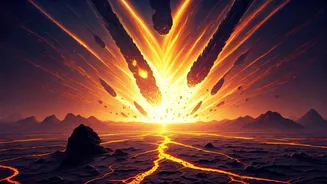
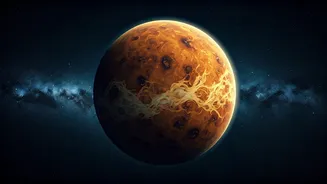
Picture the early Earth, around 4.5 billion years ago. It was a hellish landscape known as the Hadean eon. The surface was a molten magma ocean, constantly bombarded by asteroids and comets left over from the formation of the solar system. The atmosphere
was a toxic, suffocating blend of gases, completely alien to the oxygen-rich air we breathe today. In this chaotic environment, it’s hard to imagine how life could ever gain a foothold. This early Earth was more likely to sterilise life than to support it. So how did we get from a ball of fire and rock to the lush, living planet we know?
The Paradox of Creative Destruction
The traditional view is that this constant bombardment, known as the “Late Heavy Bombardment,” would have vaporised oceans and melted the crust, making life impossible. Any fledgling life forms would have been repeatedly wiped out. However, a growing body of research is flipping this idea on its head. Scientists now propose that these massive impacts, while catastrophically destructive on the surface, may have had a creative, life-giving effect deep within the planet’s crust. The paradox is that the very events that seemed like extinction-level threats might have been the catalysts that turned our planet into a cradle for life. It wasn't in spite of the violence, but perhaps because of it.
Forging a Habitable Crust
One of the key problems for early Earth was its incredible heat. A thick, insulating crust would have trapped this heat, keeping the surface too hot for liquid water. Giant impacts provided a radical solution. According to computer models, a collision with a space rock hundreds of kilometres wide could have dramatically reshaped the planet’s crust. Such an impact could have buried large amounts of heat-producing radioactive elements like uranium and thorium deep into the mantle. This would have helped the surface cool down much faster, allowing for the formation of stable continents and liquid water oceans. In a sense, the asteroids performed a kind of planetary-scale surgery, removing the source of a fever and allowing the planet to cool.
Cosmic Pressure Cookers for Life
Beyond simply cooling the crust, these impacts may have created the perfect laboratories for life to begin. The immense energy from an impact would have created vast, long-lasting hydrothermal systems. Think of them as natural, super-sized versions of the deep-sea vents we see today, like planetary pressure cookers. In these systems, water circulates through heated, fractured rock, creating a rich chemical soup. These environments are protected from the harsh radiation at the surface and are full of the energy and chemical ingredients needed to form complex organic molecules—the building blocks of life. Many scientists believe these impact-generated hydrothermal vents could have been the ideal incubators for the first living organisms.
A Special Delivery From Space
Finally, space rocks weren't just about brute force; they were also a delivery service. Earth is relatively close to the Sun, and scientists have long wondered how it held onto its vast oceans. One leading theory is that water was delivered to Earth after it cooled, ferried here by water-rich comets and asteroids. These same celestial bodies are also known to carry simple organic compounds, like amino acids. While these compounds are not life itself, they are the essential pre-written code needed to build it. By bombarding the early Earth, space rocks didn't just deliver destruction; they also delivered the two most crucial ingredients for the recipe of life: water and organic matter.