



The Challenge: Navigating a Space Bullet
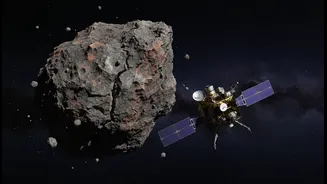
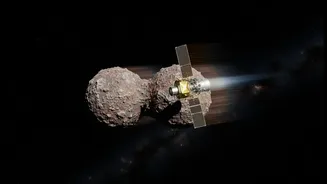
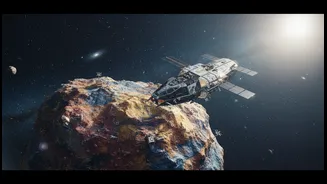
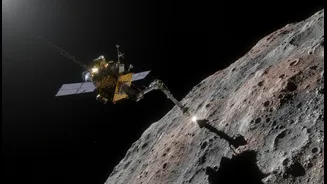
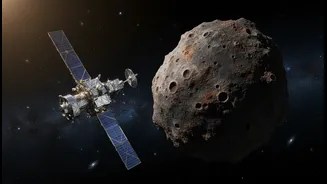
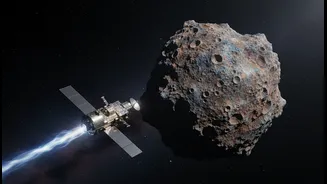
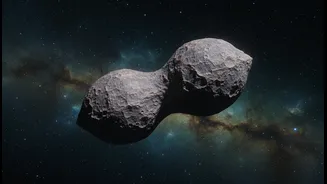
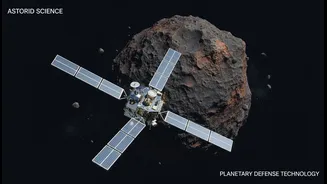
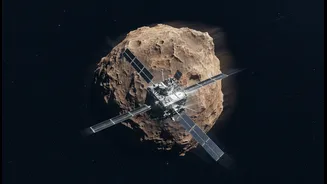
Imagine trying to take a high-resolution photo of a specific coin in another city while flying past it in a jet. That's the scale of the challenge JAXA, Japan's space agency, just overcame. The Hayabusa2 probe flew past the 450-metre-wide Torifune asteroid
at a relative speed of about 18,000 kilometres per hour. Unlike planets, asteroids are small, dark, and their orbits have uncertainties. This means the probe's navigation team could only get a visual lock on Torifune a few days before the encounter, requiring last-minute, high-stakes trajectory adjustments. The goal was to get as close as possible without crashing to gather the best data, a manoeuvre JAXA officials compared to hitting a one-yen coin in Hokkaido from Okinawa. This successful test of high-precision guidance is a monumental achievement in deep-space navigation.
The Science: A Glimpse of a New World
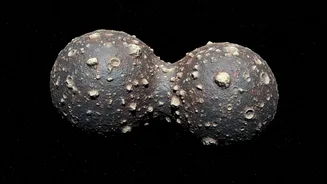
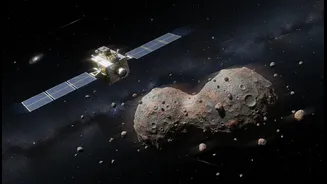
Even a fleeting glimpse can reveal a universe of information. The primary mission to Ryugu involved landing and collecting samples, but this high-speed flyby of Torifune offers a different kind of science. Initial images have already revealed Torifune's fascinating shape: it's a 'contact binary', looking like two asteroids that gently fused together to form a peanut-shaped object. By using its suite of instruments, including near-infrared and thermal imagers, Hayabusa2 gathered data on the asteroid's composition, surface temperature, and texture in the few hours around its closest approach. This data will help scientists understand the diversity of near-Earth asteroids. Torifune is a stony S-type asteroid, different from the carbonaceous C-type Ryugu, providing a crucial point of comparison for understanding how these building blocks of the solar system formed and evolved.
The Defence: A Rehearsal for Saving the Planet
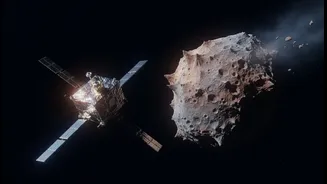
Beyond pure science, the Torifune flyby was a crucial dress rehearsal for planetary defence. The very same precision guidance technology needed to narrowly miss an asteroid is what you would need to intentionally hit one. Should a dangerous asteroid ever be discovered on a collision course with Earth, a 'kinetic impactor'—a probe designed to crash into it and alter its path—is one of our leading defence strategies. Such a mission would require a rapid reconnaissance flyby first to understand the target's size, shape, and structure before sending the impactor. This flyby successfully demonstrated the techniques needed for such a rapid response mission. By proving it can navigate to a small, fast-moving target with pinpoint accuracy, JAXA has shown it possesses a key technology for global efforts to protect our planet.
What's Next for the Intrepid Explorer?
The Torifune flyby is not the end of the journey for this remarkably resilient spacecraft. Having completed its primary mission and this successful flyby, Hayabusa2 is now on a long cruise towards its final target. In 2031, it is scheduled to rendezvous with 1998 KY26, an extremely small and rapidly rotating asteroid only about 30 metres in diameter. Studying an object of this size—comparable to the one that exploded over Chelyabinsk, Russia in 2013—is vital for planetary defence, as these smaller asteroids are numerous and difficult to detect from Earth. The extended mission, dubbed Hayabusa2#, proves the incredible value that can be extracted from a single space probe, pushing the boundaries of engineering, science, and our ability to safeguard our future.