

The Sun’s Unseen Threat
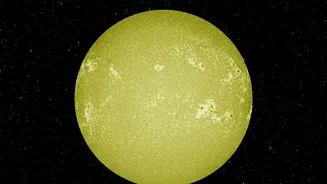
The Sun, our source of light and life, has a volatile side. It occasionally releases massive bursts of energy and particles, known as coronal mass ejections (CMEs). These events create what is known as space weather. When a powerful CME is aimed at Earth,
it can interact with our planet's magnetic field, causing a geomagnetic storm. While this can produce beautiful auroras, it also poses a serious risk to our infrastructure. The storm can create powerful, low-frequency electrical currents on the Earth's surface called geomagnetically induced currents (GICs). These currents are the main problem for power grids. They can flow into long transmission lines and enter high-voltage transformers, causing them to overheat, saturate, and potentially fail, leading to widespread blackouts and costly damages. The 1989 blackout in Quebec, which left six million people without power, is a stark reminder of this threat.
Our Eyes in the Sky
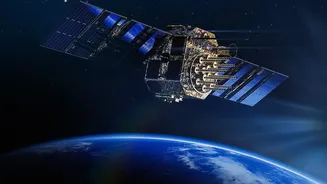
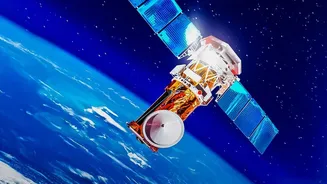
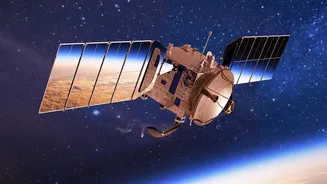
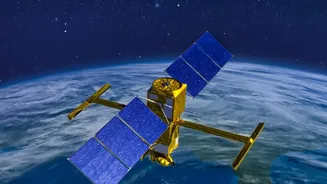
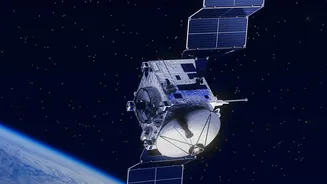
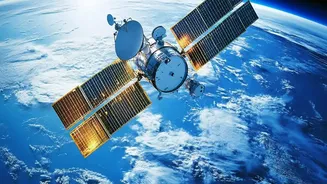
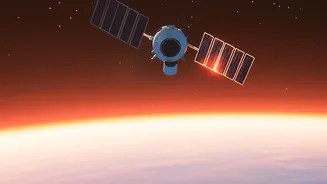
To avoid being caught by surprise, scientists rely on a fleet of dedicated satellites that act as our space weather watchtowers. A key location for these observatories is the Lagrange Point 1 (L1), a gravitationally stable spot about 1.5 million kilometres between the Sun and Earth. From this vantage point, satellites can continuously monitor the Sun without Earth blocking their view. Spacecraft like NASA's Deep Space Climate Observatory (DSCOVR) and India's Aditya-L1 mission are positioned here. These satellites are equipped with instruments to measure the solar wind—the stream of charged particles constantly flowing from the Sun. They measure its speed, density, and, most importantly, the direction and strength of its embedded magnetic field. This data provides the first clues about a potentially hazardous solar storm hurtling toward us.
The Race Against Time
Once a satellite like DSCOVR or Aditya-L1 detects a threatening solar outburst, the clock starts ticking. A CME can take anywhere from 12 to 72 hours to travel from the Sun to Earth. The data from the L1 point provides a crucial early warning, typically giving forecasters between 15 to 60 minutes of lead time before the storm's main impact. This information is beamed to space weather prediction centres on the ground, such as the National Oceanic and Atmospheric Administration's (NOAA) Space Weather Prediction Center (SWPC) in the United States. Forecasters there analyse the data, use computer models to predict the storm's severity and potential impact, and then issue watches, warnings, and alerts to relevant authorities and industries. These alerts are scaled to communicate the severity of the expected geomagnetic disturbance, much like hurricane categories.
Bracing for Impact on the Ground
When a grid operator receives a high-level alert from a prediction centre like SWPC, they don't just wait for the storm to hit. This early warning is the key to protecting the grid. Operators can take several preemptive measures to brace the system. They might postpone non-essential maintenance to ensure all hands are on deck, re-route power across their network to reduce stress on the most vulnerable lines, or temporarily take certain large transformers offline to prevent them from absorbing the damaging geomagnetically induced currents. Some modern systems even include specialised equipment, known as neutral blocking devices, designed to physically block GICs from damaging transformers. The goal is to operate the grid more conservatively until the storm passes, reducing the risk of a cascading failure that could lead to a widespread blackout.
India’s Solar Guardian
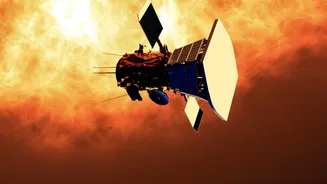
India has significantly boosted its role in global space weather monitoring with the successful Aditya-L1 mission. Launched by the Indian Space Research Organisation (ISRO), Aditya-L1 is the nation's first dedicated solar observatory. Its position at the L1 point allows its seven payloads to study the Sun's atmosphere and track solar storms. The data it gathers on CMEs and the solar wind is vital for understanding and forecasting space weather events that could impact India. In fact, data from Aditya-L1 has already been crucial in analysing major solar storms in collaboration with international space agencies, enhancing our global understanding of these phenomena. This not only helps protect India's own critical infrastructure, from power grids to satellites, but also contributes to the worldwide effort to prepare for the Sun's powerful outbursts.