




A Celestial Season Begins
August marks the start of the prime viewing season for Saturn in 2026. While the planet is visible at other times, the coming weeks are special. This period leads up to a major celestial event known as 'opposition', which for Saturn occurs this year on October
4. During opposition, Earth passes directly between the Sun and Saturn. Think of it like a celestial alignment where Saturn is on one side of Earth and the Sun is on the other. This means the planet rises in the east around sunset, remains visible all night long, and sets in the west around sunrise, making it incredibly convenient to observe.
Why This Is a Great Chance
The geometry of opposition means two things for viewers on Earth: Saturn is at its closest point to our planet for the year, and its face is fully illuminated by the Sun. This combination makes the planet appear at its largest and brightest in our sky. Although the peak of this brightness will be in October, the build-up throughout August and September means the planet is already an excellent target. To the naked eye, it will appear as a bright, steady, yellowish point of light, noticeably brighter than many surrounding stars. Unlike stars, which twinkle, planets typically shine with a more constant glow.
How to Find Saturn This Month
Finding Saturn in August is getting easier each night. The planet will be visible in the eastern sky, rising before midnight and climbing higher as the night progresses. For viewers in India, it will be located in the constellation Cetus. The best way to pinpoint its exact location is to use a free stargazing app on your smartphone, such as Stellarium or SkySafari. These apps use your phone's sensors to show you a real-time map of the sky. Simply search for Saturn, and the app will guide your gaze. For the best experience, find a location away from bright city lights to allow your eyes to adapt to the darkness.
What You Can Expect to See
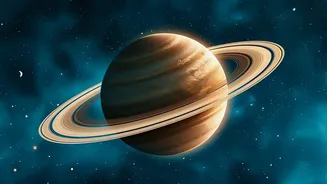
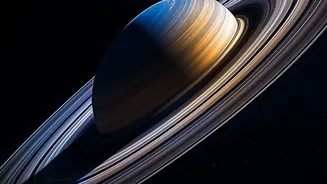
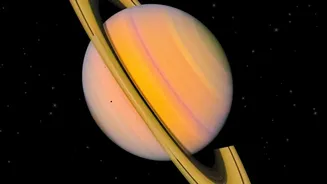
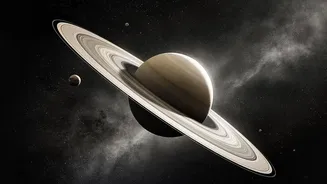
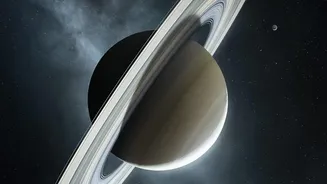
The view you get depends entirely on your equipment. With just your naked eye, Saturn will look like a bright, non-twinkling star. A good pair of binoculars, held steady or mounted on a tripod, might reveal that the point of light is not perfectly round but slightly oval-shaped, a subtle hint of the famous rings. But to truly experience the magic, you need a telescope. Even a small, basic telescope with 60mm aperture or more will be able to resolve the rings as a distinct structure separate from the planet itself. It's a genuinely breathtaking sight that no photograph can truly capture. With a larger amateur telescope, you might even spot the Cassini Division—a dark gap in the rings—or Saturn's largest moon, Titan, appearing as a tiny pinprick of light nearby.
A Special Year for the Rings
This year offers a particularly interesting view of Saturn's famous rings. Due to the planet's 29-year orbit, our viewing angle of the rings changes over time. In 2025, we experienced a 'ring plane crossing', where the rings were turned almost perfectly edge-on to us, making them nearly disappear from view. In 2026, the rings are beginning to tilt back towards us. While the angle is still narrow at around 7.5 degrees, it means the rings are once again becoming a clear and beautiful feature, and their visibility will only improve in the years ahead. This makes 2026 a great year to witness their celestial comeback.