






Meet the 'Hycean' World
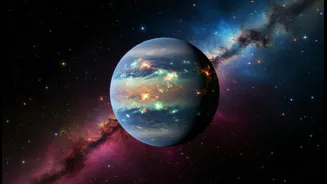
K2-18b is not an Earth-like planet. It’s a sub-Neptune, about 8.6 times the mass and 2.6 times the radius of our own world. It orbits a cool red dwarf star within the habitable zone, a region where conditions could be right for liquid water to exist on a planet's
surface. This planet is the prototype for a theoretical class of worlds called 'Hycean' planets—a portmanteau of 'hydrogen' and 'ocean'. The concept, proposed by astronomers at the University of Cambridge, describes planets with global liquid water oceans underneath hydrogen-rich atmospheres. This idea expands the search for life beyond small, rocky planets, as larger Hycean worlds are easier to observe.
A Tantalizing Chemical Signal
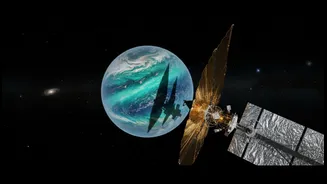
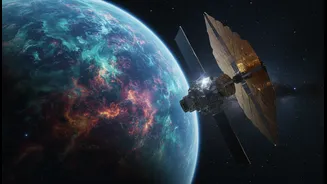
The excitement centers on observations made by the James Webb Space Telescope (JWST). While studying the light from K2-18b's star as it filtered through the planet's atmosphere, an international team of scientists found evidence of carbon-bearing molecules like methane and carbon dioxide. More thrillingly, they reported a possible detection of a molecule called dimethyl sulfide (DMS). On Earth, DMS is overwhelmingly produced by life, particularly by marine microbes like phytoplankton. This makes it a compelling 'biosignature'—a substance that could indicate the presence of biological processes. The initial report suggested this was the strongest evidence yet for potential life on an exoplanet.
The Case for Scientific Caution
The word 'may' in the headline is doing a lot of work. The detection of DMS is far from confirmed. The initial findings had what scientists call a 'three-sigma' level of statistical confidence. While that means there's a 99.7% chance the signal is real, the gold standard for a scientific discovery is 'five-sigma,' which requires a much higher degree of certainty. Furthermore, subsequent analyses by other teams have questioned the findings. Some studies suggest the signal could be statistical noise or that other molecules, like the hydrocarbon propyne, might fit the data better than DMS. There is also the possibility that DMS could be produced by unknown non-biological, or abiotic, processes on a world so different from our own.
An Ongoing Scientific Debate
The very nature of K2-18b is still debated. While one team champions the Hycean ocean world model, other interpretations of the data suggest it could be a gas-rich mini-Neptune or even host a 'magma ocean' beneath its thick atmosphere, making it entirely inhospitable. Some models indicate the planet would be too hot for a liquid water ocean unless it has significant cloud cover, which hasn't been detected yet. This back-and-forth is a normal and healthy part of the scientific process. Extraordinary claims require extraordinary evidence, and every aspect of the K2-18b data is being scrutinized by the global scientific community.
What Happens Next in the Search?
Regardless of the final verdict on DMS, K2-18b has become a crucial laboratory for the search for life. The team behind the initial detection is planning further observations with the JWST, hoping to gather enough data to either confirm the signal with higher confidence or rule it out. Other scientists are working on models to understand what kinds of abiotic chemistry could occur in hydrogen-rich atmospheres, which could help determine if DMS is truly a reliable sign of life on such planets. This intense focus marks a new era in astrobiology, where we have finally developed the tools to not just find exoplanets, but to probe their atmospheres for potential signs of life.