




What You're Looking For
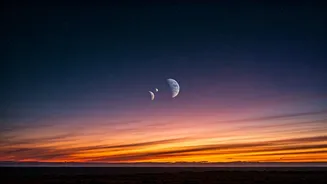
Tonight, the planets Jupiter, Mercury, and Mars will appear clustered together in the sky from our perspective here on Earth. This isn't an 'alignment' in the sense of a straight line in space—the planets are, of course, millions of kilometres apart.
Instead, it's a beautiful line-of-sight event called a conjunction. From our viewpoint, they will form a small, eye-catching triangle or cluster. Jupiter will be the brightest of the trio, shining with a steady, brilliant light. Mercury is often elusive, but in this grouping, it will be easier to spot. Mars, with its faint reddish hue, completes the celestial trio. Think of it as a temporary cosmic landmark, a brief gathering of our planetary neighbours in one small patch of the evening sky.
The Perfect Time and Place
Timing and location are everything for this event. The key is to look towards the west-northwest horizon shortly after sunset. The best viewing window will open about 30 minutes after the sun has fully set and will last for roughly an hour. After that, the planets will follow the sun and dip below the horizon. Because they are “low on the horizon,” you will need a clear, unobstructed view. Balconies or rooftops with a clear westward view are ideal. If you're in a dense urban area, try to find a park, a sports ground, or an overpass that gives you a clear line of sight to the horizon, away from tall buildings or trees. The sky will need to be dark enough for the planets to pop out, but you can't wait too long or they'll be gone.
No Telescope? No Problem
One of the best things about planetary conjunctions is that they are typically naked-eye events. You do not need any special equipment to witness this cosmic get-together. Jupiter is one of the brightest objects in the night sky, and it will serve as your anchor point. Once you spot it, look nearby for the other two, slightly fainter points of light. While your eyes are all you need, a pair of binoculars will dramatically enhance the experience. With binoculars, you might even be able to see the tiny discs of the planets. If you have a telescope, you'll be in for a real treat. With enough magnification, you could potentially spot Jupiter's four largest moons—Io, Europa, Ganymede, and Callisto—appearing as tiny pinpricks of light lined up beside the giant planet.
Tips for Urban Stargazers
Viewing celestial events from a light-polluted Indian city can be challenging, but not impossible. First, get as high up as you can. A tall apartment building's terrace is much better than the street level. Second, give your eyes time to adapt. Turn away from your phone and any bright lights for at least 10-15 minutes. This will help your pupils dilate, making you more sensitive to the faint light of Mercury and Mars. Third, use a stargazing app on your phone (like Stellarium or SkyView) beforehand to get your bearings. You can point your phone at the sky to identify which direction west is and see a simulation of where the planets will be. Just remember to put the phone away when it's time to actually look, so you don't ruin your night vision.
How Rare Is This, Really?
While headlines often scream “rare,” the reality is a little more nuanced. Conjunctions involving two or three planets happen with some regularity—every year or two. However, each one is unique. The specific planets involved, their brightness, how tightly they are grouped, and their position in the sky make every event a distinct spectacle. So, while it's not a once-in-a-lifetime occurrence like a major comet, it is a special and fleeting event that is absolutely worth your time. It’s a moment of cosmic alignment that reminds us of the grand, clockwork motion of our solar system, visible for a short while from our own backyards. Don't miss the chance to see it.