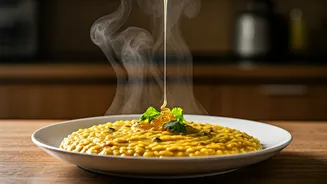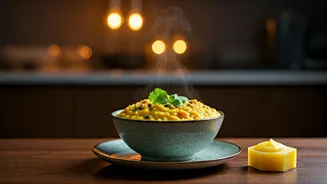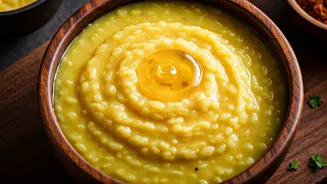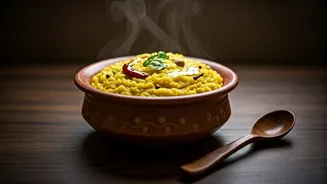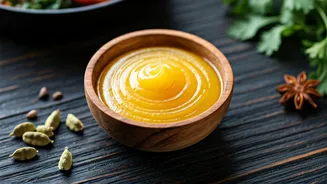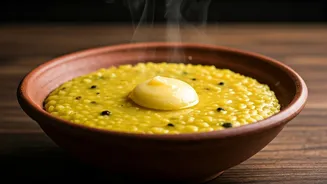



First, What Makes Ghee Special in Khichdi?
Ghee has been a cornerstone of Indian cooking for millennia, cherished for both its flavour and its Ayurvedic properties. When added to simple dishes like dal or khichdi, it does more than just add fat. Ghee has a high smoke point (around 250°C), which
makes it perfect for creating a *tadka* (tempering) of spices like cumin and asafoetida. [11] This process, known as blooming, releases the spices' essential oils, creating a deep, aromatic flavour base that oil simply cannot replicate. [11, 18] Beyond flavour, ghee helps the body absorb fat-soluble vitamins from other ingredients and adds a rich, satisfying mouthfeel that turns a basic meal into an indulgent experience. [12, 16]
Decoding 'A2': It’s All in the Cow’s DNA
The term 'A2' refers to the type of beta-casein protein found in the milk. Most commercial dairy in India comes from crossbred or European cow breeds (like Holstein Friesian, Jersey) that produce milk containing A1 beta-casein. [4] In contrast, A2 milk comes from indigenous Indian breeds like Gir, Sahiwal, and Red Sindhi. [1, 4] The structural difference lies in a single amino acid. [3] A2 beta-casein is considered by many to be easier to digest because it doesn't break down into beta-casomorphin-7 (BCM-7), a peptide that some studies link to digestive discomfort and inflammation in sensitive individuals. [4, 5] While the clarification process to make ghee removes most casein and lactose, ghee made from A2 milk is often preferred for its perceived gentleness on the gut. [5, 6, 21]
The Art of 'Wood-Pressed': The Bilona Method
‘Wood-pressed’ refers to the traditional *bilona* method of making ghee. This is a slow, deliberate process that stands in stark contrast to modern industrial production. [14, 19] It begins with converting whole A2 milk into curd. [13] This curd is then churned with a wooden churner, the 'bilona', to separate the butter (makkhan). [13, 14] Finally, this butter is slow-cooked over a low flame, often over firewood, until the water evaporates and the milk solids lightly caramelise, leaving behind pure, golden ghee. [14, 17] This low-heat process is crucial; it preserves heat-sensitive vitamins like A, D, E, and K, along with the ghee's nutty aroma and characteristic grainy texture, which are often lost in high-heat commercial methods. [10, 19]
The Transformation: Flavour, Aroma, and Nutrition
So, what happens when this specific ghee meets your dal khichdi? The transformation is multi-layered. First, the aroma. The bilona method gives A2 ghee a distinctly rich, nutty fragrance that commercial ghee lacks. [10, 20] When you add it to hot khichdi, this aroma blossoms, signalling a more complex flavour profile. The taste is deeper and creamier, enhancing the earthiness of the dal and rice without overpowering them. [16] Nutritionally, you are getting a purer product, rich in butyric acid, which is excellent for gut health, and Conjugated Linoleic Acid (CLA), which is linked to healthy metabolism. [2, 7, 21] Because it’s made from A2 milk and is virtually lactose-free, it’s often better tolerated by those with dairy sensitivities. [6, 22]