




Maharashtra: The Epicentre of Grandeur
For the grandest public celebrations, Maharashtra is the place to be. Cities like Mumbai and Pune are famous for their enormous pandals (temporary stages), some of which are breathtakingly elaborate. The festival, known here as Ganeshotsav, transforms
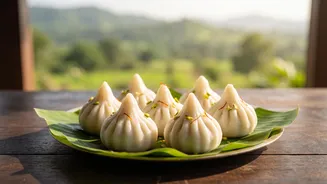
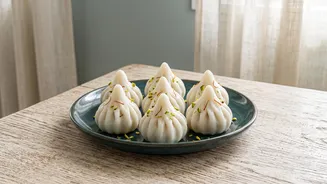
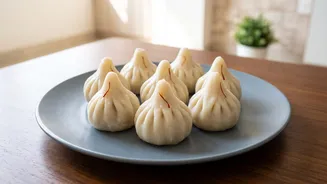
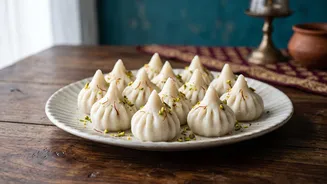
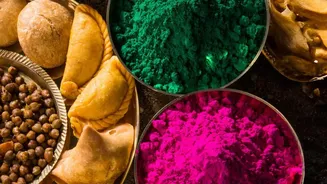
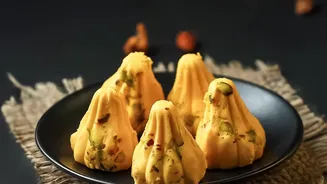
into a massive public spectacle, especially on the final day of immersion, or 'visarjan'. The streets fill with the energetic beats of dhol-tasha drums as massive crowds lead the idols to the sea. The culinary star, without a doubt, is the 'ukadiche modak'—a steamed rice-flour dumpling filled with a sweet mixture of fresh coconut and jaggery. This delicate sweet is considered Lord Ganesha's favourite, and no celebration is complete without it. Alongside it, you will find savoury snacks and other sweets like 'puran poli', a sweet flatbread with a lentil filling, and 'karanji', a fried pastry.
Goa: A Flavourful Konkani Celebration
In Goa, the festival, known locally as 'Chovoth', takes on a more intimate, family-oriented character. While Maharashtra focuses on public grandeur, Goa's celebrations are deeply rooted in ancestral homes, making it a time for families to reunite. A unique Goan tradition is the 'matoli', a wooden canopy decorated with seasonal local produce, which is hung over the Ganesha idol. The food here reflects its Konkani heritage and coastal setting. While modaks are also prepared, a special delicacy is the 'patoli' or 'patholi', where a rice-flour paste with a coconut-jaggery filling is steamed inside fragrant turmeric leaves. The festive meal is extensive and entirely vegetarian, featuring dishes like 'khatkhate', a mixed vegetable stew with at least five vegetables, and 'mooga gathi', a sprouted green gram curry.
Karnataka: A Joint Celebration of Mother and Son
In Karnataka, the festival often begins a day early with Gowri Habba, celebrating Ganesha's mother, Goddess Gauri. The following day, Ganesh Habba begins, with Ganesha's idol placed alongside his mother's, symbolising his visit to take her back to Mount Kailash. The food offerings here are a delightful mix of sweet and savoury. A key sweet is 'karjikai' (or 'karigadubu'), a crispy fried dumpling similar to a gujiya, filled with dry coconut and sugar. You'll also find 'chakli', a spiral-shaped savoury snack, and 'kobbari mithai', a type of coconut barfi. A unique prasad offered in many temples and homes is 'panchakajjaya', a dry mixture of roasted lentils, jaggery, coconut, and sesame seeds. In coastal Karnataka, you can also find 'kotte kadubu', which are savoury idlis steamed in jackfruit leaves.
Tamil Nadu & Andhra Pradesh: A Devotion to Dumplings
In the southern states, the festival is widely known as Vinayaka Chaturthi. Here, the celebrations are often marked by a focus on eco-friendly clay idols and heartfelt home prayers. The culinary offerings share similarities with other regions but have their own distinct identities. In Tamil Nadu, the star is the 'kozhukattai', a steamed rice-flour dumpling that is the South Indian counterpart to the modak. It comes in both sweet (filled with coconut and jaggery) and savoury (uppu kozhukattai) versions. In Andhra Pradesh and Telangana, similar dumplings are called 'kudumulu' and 'undrallu'. 'Undrallu' are often savoury steamed rice rava balls, sometimes with chana dal, while 'kudumulu' can be sweet. Another classic offering is 'sundal', a simple and nutritious dish made from boiled chickpeas or other legumes, lightly tempered with spices and topped with coconut.