

The Billion-Dollar Truth Machine
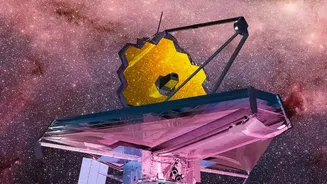
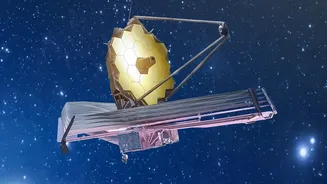
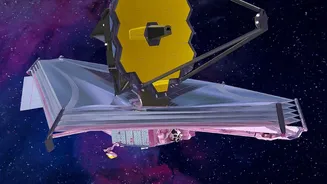
The James Webb Space Telescope (JWST) is the most powerful space observatory ever built, a multi-billion dollar investment in answering humanity's biggest questions. One of its key missions is to study exoplanets—planets orbiting other stars—to look for
signs of habitability. It does this by using a technique called transit spectroscopy. When a planet passes in front of its star, a tiny fraction of starlight filters through the planet's atmosphere. By analysing the spectrum of that light, scientists can determine what gases are present. For years, astronomers have dreamed of finding biomarkers like oxygen and methane. While Webb has been incredibly successful, detecting water and other molecules, it's also delivering a more sobering truth: finding the right conditions for life is harder than we thought. These findings, while not about discovering life, are crucial for the business of astronomy, helping to focus future research and investment on the most promising targets.
A Case of a Missing Atmosphere
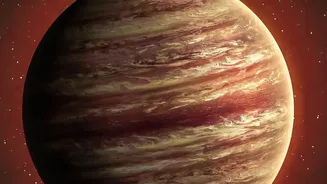
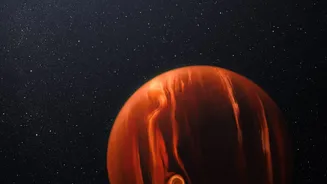
Recent observations have focused on rocky planets orbiting M-dwarf stars, which are the most common type of star in our galaxy. These stars are smaller and cooler than our sun, meaning planets must orbit much closer to them to be in the 'habitable zone' where liquid water could exist. However, studies of planets like GJ 1252 b, a 'super-Earth' about 65 light-years away, are painting a bleak picture. Data from Webb and other telescopes suggest that GJ 1252 b, despite being a rocky world not much larger than our own, likely has no atmosphere at all. Its dayside temperature is estimated to be over 1,200 degrees Celsius, hot enough to melt gold and copper. Researchers concluded that even if the planet had 700 times the carbon dioxide of Earth, it wouldn't be enough to sustain an atmosphere, which would be eroded away by the star.
The Violent Life of a Red Dwarf Star
The culprit behind this atmospheric destruction is the star itself. M-dwarf stars, especially when they are young, are incredibly active. They unleash powerful flares and intense high-energy radiation, including X-rays and ultraviolet light. For a planet orbiting as close as GJ 1252 b does, this constant bombardment is like standing in front of a powerful blow-dryer. The immense radiation pressure and stellar wind physically strip the gases away from the planet in a process called photoevaporation. Over millions of years, this can erode an entire atmosphere, leaving behind a barren, super-heated rock. This process is a major challenge for habitability, as a stable atmosphere is needed to protect a planet's surface from harmful radiation and maintain the right pressure for liquid water.
Refining the Search for Another Earth
Discovering a planet has no atmosphere might sound like a failure, but in the scientific community, it's a vital piece of the puzzle. These findings help scientists understand the 'cosmic shoreline'—the boundary line that separates planets that can hold onto their atmospheres from those that can't. Knowing that planets orbiting very close to active M-dwarfs are likely to be desolate worlds allows astronomers to refine their search. It suggests that the best places to look for life might be around more stable, sun-like stars, or on planets orbiting M-dwarfs at a much greater, safer distance. The James Webb Space Telescope's ability to rule out worlds is just as important as its ability to find promising ones. Each 'empty' planet provides crucial data points that narrow down the vast cosmic ocean, bringing us one step closer to knowing where to point our telescopes next in the enduring quest to find another Earth.