



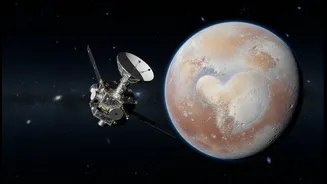



A Journey Beyond the Destination
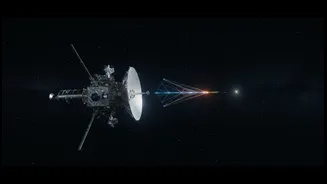
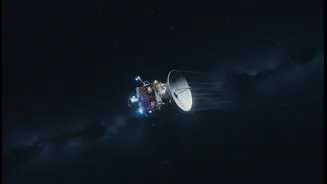
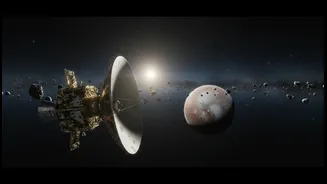
Launched in 2006, New Horizons was the fastest human-made object ever launched from Earth. Its primary goal was audacious: to travel for nearly a decade and more than three billion miles to perform the first-ever flyby of Pluto. It succeeded spectacularly
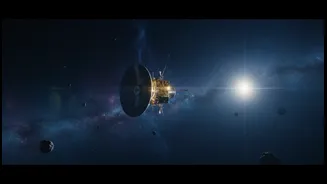
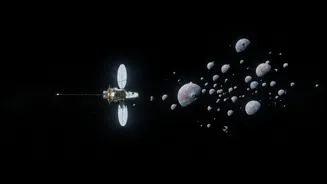
in July 2015, transforming our view of the dwarf planet from a fuzzy dot into a complex world. But that was just the beginning. In 2019, the probe studied Arrokoth, the most distant object ever explored up close. Since then, its extended mission has turned it into a deep-space observatory, probing the mysterious Kuiper Belt and the outer edges of the Sun's influence, known as the heliosphere.
Powering a Marathon Runner
How do you power a spacecraft where the Sun is just a distant star? Solar panels are useless in the Kuiper Belt, where solar energy is about a thousand times weaker than it is near Earth. The answer is a Radioisotope Thermoelectric Generator, or RTG. This nuclear battery uses the heat from the natural decay of plutonium-238 to generate a steady supply of electricity. While the power output slowly decreases over time—a loss of about four watts per year for similar probes like Voyager—the RTG on New Horizons was designed to provide power for decades, enabling its long journey and continued operations far from home. This technology is a cornerstone of deep space exploration, having powered missions like Voyager, Cassini, and the Mars rovers.
The Art of Long-Distance Maintenance
Keeping a complex machine working for decades is a challenge on Earth; doing it from billions of miles away is an engineering marvel. At its current distance, a radio signal from Earth takes nearly nine hours to reach New Horizons. This immense communication delay means the spacecraft must be highly autonomous, capable of handling situations on its own. To conserve power and reduce operational costs, engineers frequently place the probe into hibernation mode for long cruise periods. Just recently, in June 2026, it woke up from a 321-day slumber, its longest yet, with all systems reported as healthy. This strategy extends the spacecraft's life, allowing it to continue gathering valuable science data even while resting.
Teaching an Old Probe New Tricks
A key to the longevity of probes like New Horizons and its predecessors, the Voyager spacecraft, is the ability to send software updates across the vastness of space. Engineers on the ground can transmit new commands and patches to fix issues, optimize systems, and even upload new capabilities. This allows the mission to adapt to new scientific objectives and work around aging hardware. For instance, teams can reconfigure systems to draw power from different circuits or shut down non-essential instruments to conserve energy, as has been done with the Voyager probes. This remote-control ingenuity is what allows a machine designed in the early 2000s to continue performing cutting-edge science decades later.
A Resilient Design Philosophy
From the beginning, New Horizons was built for the long haul. Engineers anticipated the harsh environment of deep space, which includes extreme temperatures and radiation. To survive, the design incorporates redundancy, meaning it has backup systems for critical components. This foresight is crucial, because physical repairs are impossible. Engineers use a process sometimes called a "fault tree" to anticipate potential failures and design safeguards before the mission ever launches. This philosophy of building durable, reliable, and adaptable machines is what enables these decades-long voyages. The spacecraft’s success is not just in the data it collects, but in its very survival, pushing the limits of what is possible in robotic exploration.