





The Fuel Problem in Space
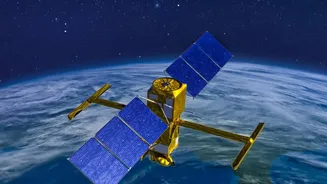
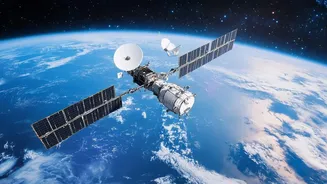
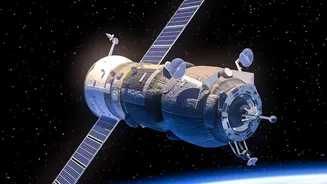
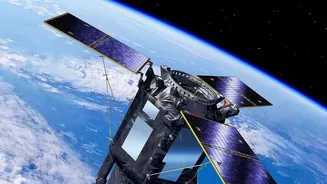
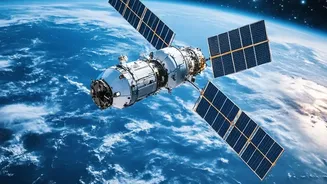
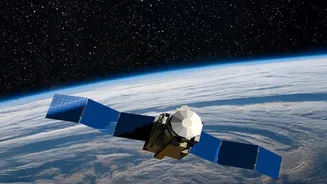
For decades, the lifespan of a satellite in low-Earth orbit (LEO) has been dictated by one simple constraint: the amount of fuel it can carry. Satellites in LEO, especially those in very low orbits (VLEO) below 400 kilometres, constantly fight against
atmospheric drag. Even in what we consider the vacuum of space, there are enough residual gas molecules to slow a satellite down, causing its orbit to decay. To counteract this, satellites must fire their thrusters, but every firing consumes precious onboard propellant. Once the fuel tank is empty, the mission is effectively over, and the multi-million dollar satellite eventually burns up re-entering the atmosphere. This limitation not only curtails the operational life of satellites but also adds significant weight and cost to their launch.
A Revolutionary Solution: Breathing in Space
Air-breathing electric propulsion (ABEP), also known as a Ram-EP, is a game-changing technology that offers a way around this fundamental problem. Instead of carrying its own propellant, an ABEP system uses an intake to scoop up the sparse atmospheric molecules it encounters in VLEO. These collected particles—mostly atomic oxygen and nitrogen—are then used as the propellant for an electric thruster. By using the very atmosphere that creates drag as a fuel source, these thrusters can generate thrust to compensate for that drag, potentially allowing a satellite to maintain its orbit indefinitely. The only real limit becomes the operational life of the satellite's electronic components, not its fuel supply.
How It Works: Scooping and Accelerating Air
The principle behind ABEP is elegant in its simplicity, though the engineering is complex. As the satellite travels at high speed (around 7.8 km/s), a specially designed intake collects and compresses the few air molecules in its path. These molecules are channelled into a thruster where they are ionised—given an electric charge. An electric and magnetic field, powered by the satellite's solar panels, then accelerates these newly created ions and ejects them at very high velocity. This expulsion of particles generates a small but continuous thrust, perfectly suited to counteract the equally small but continuous atmospheric drag. European and US teams, including the European Space Agency (ESA) and companies like SITAEL and Busek, have successfully tested prototypes on the ground, proving the concept is viable.
The Dawn of 'Perpetual' Missions
The implications of this technology are enormous. Operating in VLEO offers significant advantages. Earth observation satellites could capture much higher-resolution images, and telecommunication satellites could offer faster connectivity with lower latency. Until now, these benefits were offset by the short mission durations imposed by fuel consumption. With air-breathing thrusters, long-lived missions in these valuable orbits become feasible. This could transform climate monitoring, surveillance, and scientific research by providing persistent, high-fidelity data from a lower altitude. Furthermore, it promotes a more sustainable use of space. Satellites in VLEO naturally de-orbit faster when their work is done, reducing the risk of them becoming long-term space debris.
Challenges on the Horizon
Despite its promise, ABEP technology is still in its developmental stages. A key challenge is designing an intake that can efficiently collect and compress particles in the incredibly rarefied environment of VLEO. The thruster itself must be able to ionise different types of particles, as the atmospheric composition can vary. Furthermore, the materials used must be durable enough to withstand the corrosive effects of atomic oxygen, which is highly reactive in the upper atmosphere. Proving that the system can reliably generate enough thrust to overcome drag across different altitudes and atmospheric densities is the final hurdle before we see these systems deployed on operational missions. Researchers are currently working on these challenges, with projects like the EU's AETHER and studies by the UK Space Agency pushing the technology's readiness level forward.