




A World of Possibility
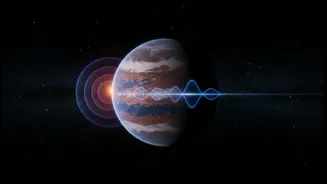
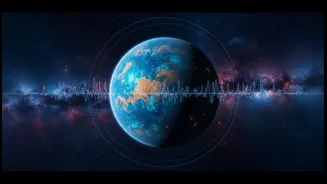
For years, K2-18b has captured the imagination of astronomers and the public alike. Located in the habitable zone of its cool red dwarf star, this planet is about 8.6 times the mass of Earth. Observations from the James Webb Space Telescope (JWST) revealed
an atmosphere containing methane and carbon dioxide. This discovery led to the compelling theory that K2-18b could be a 'Hycean' world—a planet with a deep liquid-water ocean under a hydrogen-rich atmosphere. The excitement peaked when initial JWST data twice hinted at the presence of dimethyl sulfide (DMS), a gas that, on Earth, is overwhelmingly produced by marine life. Suddenly, a world 124 light-years away became the most tantalizing target in the search for life beyond our solar system.
The Problem with False Positives
In science, extraordinary claims require extraordinary evidence. The faint hint of DMS in K2-18b's atmosphere was thrilling, but far from conclusive. Several independent teams re-analysed the same JWST data and concluded the signal wasn't statistically significant, or that other chemical processes could be at play. This is a common challenge in astrobiology: distinguishing a true biosignature from a 'cosmic false alarm'. For example, energetic activity from the host star, such as stellar flares, can create chemical signatures in a planet's atmosphere that mimic those produced by life. Without a way to rule out these non-biological sources, any claim of finding life would remain on shaky ground. The scientific community needed a different tool to get a clearer picture.
A New Tool for the Hunt
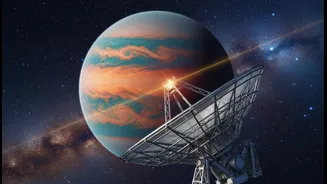
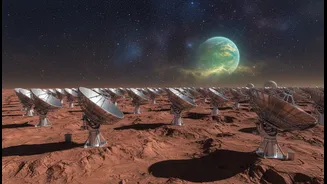
This is where the latest radio survey comes in. A recent project used two of the world's most powerful radio telescopes—the Very Large Array (VLA) in New Mexico and the MeerKAT array in South Africa—to listen to the K2-18b system. While one goal was to search for artificial radio transmissions (technosignatures) as part of the Search for Extraterrestrial Intelligence (SETI), the method itself served another vital purpose. Radio telescopes are excellent at monitoring stellar activity. By correlating radio data (which shows what the star is doing) with infrared data from JWST (which shows the planet's atmospheric chemistry), scientists can determine if a chemical like DMS is a product of life or just a result of the star's energetic outbursts. This coordinated effort provided a powerful new way to filter out misleading signals.
What the Radio Waves Told Us
After observing the system, the research team processed millions of potential signals. They employed a sophisticated five-step filtering pipeline to remove interference from Earth-based technology, account for the Doppler effect, and analyse signals across multiple telescope beams. The result? Silence. No convincing technosignatures were detected. While this might seem disappointing, it provides a crucial piece of information: if a civilization exists on K2-18b, it is not broadcasting with technology more powerful than our own strongest transmitters, like the former Arecibo radar. More importantly, the survey established a baseline for the star's radio activity, helping to constrain the possible non-biological sources for the atmospheric gases seen by JWST. The silence itself becomes a valuable data point. The true success of the survey wasn't in what it found, but in the robust methodology it proved.