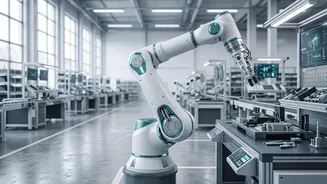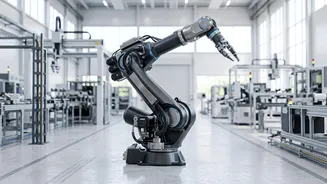


The Problem with 'Dumb' Robots
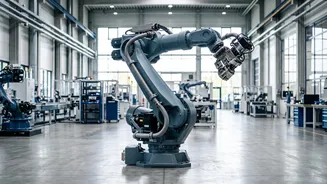
For decades, industrial robots have been the workhorses of manufacturing, but with a major limitation: they are typically programmed for one specific, repetitive task. They excel in highly structured environments where every part is in the exact same
place, every time. If an object is slightly misplaced, slippery, or of a different shape, the robot often fails, halting production. This has left huge portions of the economy, from electronics assembly to food production, reliant on human hands for tasks requiring dexterity and adaptability. Eka Robotics, a startup with roots at MIT and Google's DeepMind, aims to solve this by creating robots that aren't just programmed, but can think and feel their way through a task.
Giving Robots a Sense of Touch
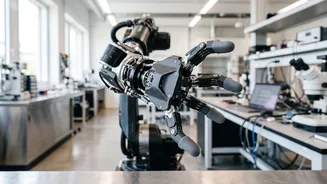
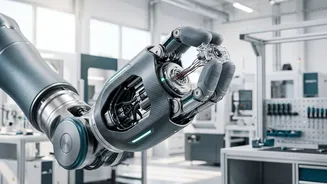
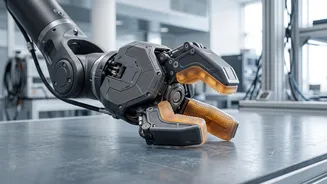
Eka's breakthrough is its 'Vision-Force-Action' (VFA) model. Instead of relying solely on cameras (vision), Eka's robots also use force sensors in their grippers to get tactile feedback—essentially, a sense of touch. This allows a robot to feel if its grip is slipping and correct it, or use the resistance from a surface to properly align a part. Co-founder Pulkit Agrawal explains that vision gets a robot close, but the final, delicate part of the action is best handled through force. This 'physical intelligence' allows the same robot to perform varied tasks like picking diverse objects, inserting wires, or even screwing in a lightbulb, adapting to unexpected changes in the real world.
The $150 Million War Chest
The $150 million fundraising round, co-led by prominent venture capital firms Andreessen Horowitz (a16z) and F-Prime, values Eka Robotics at an impressive $1.45 billion. This significant investment underscores investor confidence in the company's approach to solving one of robotics' toughest challenges. According to the company, the funds will be used to scale the technology, accelerate customer deployments, and expand the range of tasks its robots can perform. Eka is already running industrial pilots in pick-and-place work and wire handling, where its robots have demonstrated superhuman capabilities, picking up to 1,500 objects per hour—more than double the human rate.
Training Robots in the Virtual World
Rather than programming robots by physically demonstrating a task, Eka uses a method called reinforcement learning in a physics simulator. This allows the company to generate thousands of hours of robot experience in just minutes, exposing the AI to a vast range of objects, environments, and physical conditions. The AI learns through trial and error in this virtual space, building an 'intuition' about physics that can then be transferred to real-world hardware. This 'sim-to-real' approach is seen as a more scalable and efficient way to achieve the generality and performance needed for commercial deployment, moving beyond what the company calls 'lab demos' into reliable factory-floor production.
The Bigger Picture for Indian Industry
While Eka Robotics is based in the U.S., its technological advancements have significant implications for India's burgeoning manufacturing and automation landscape. The Indian industrial robotics market is projected to grow substantially, from over $1.2 billion in 2025 to more than $2.6 billion by 2031. The country is already a top-10 global market for robot installations, driven by sectors like automotive and electronics. The arrival of highly adaptive, general-purpose robots could accelerate this trend, enabling Indian manufacturers to automate complex tasks that were previously out of reach. This aligns perfectly with national initiatives to boost domestic production and competitiveness on the global stage, making factories smarter, more flexible, and more productive.