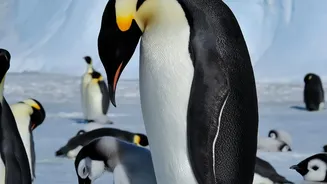





The Antarctic winter is one of Earth’s most brutal environments, with temperatures dropping below -50°C and winds howling at over 150 km/h. Yet, this is where the emperor penguin chooses to breed. Their secret to survival is the huddle.
The Coldest March on Earth
Emperor penguins
are the only vertebrates to breed during the harsh Antarctic winter. After the female lays a single egg, she transfers it to the male and returns to the sea to feed for up to two months. This leaves the males to incubate the eggs alone, fasting for around 115 days and facing the planet’s most extreme weather. To endure months of darkness, blizzards, and unimaginable cold, these remarkable birds must rely on each other. Their individual layers of feathers and fat, while impressive, are not enough. Survival is a team sport, and the penguins' strategy is a masterclass in cooperation.
A Symphony of Survival
The huddle is the penguins' primary defense against the cold. By packing together in dense groups of up to several thousand individuals, they drastically reduce the amount of body heat each penguin loses to the environment. This cooperative behavior is so effective that it can cut heat loss by half. Temperatures inside a huddle can soar to over 20°C, and even reach a balmy 37.5°C in the center, a stark contrast to the frigid air outside. This shared warmth is crucial for conserving the energy the males need to survive their long fast and keep their precious eggs from freezing.
The Physics of the Huddle
A penguin huddle is more than just a random crowd; it’s a highly organized, dynamic system that scientists compare to a physical phase transition, like water turning to ice. The penguins pack so tightly, with as many as ten birds per square meter, that individual movement becomes nearly impossible, creating a state similar to jammed particles. However, the huddle must remain mobile to allow penguins on the cold periphery to move inward. The solution is a marvel of collective coordination. Approximately every 30 to 60 seconds, a penguin will take a tiny step, creating a ripple effect. This step triggers a wave of coordinated movements that travels through the entire group, allowing the huddle to slowly reorganize without breaking apart.
Not Just a Scrum, But a System
These coordinated waves ensure that no single penguin is permanently left on the freezing outer edge of the huddle. The constant, slow shuffling allows for a continuous rotation of individuals from the exterior to the warm interior. Any penguin can initiate a movement, and as gaps as small as two centimeters appear, the huddle instinctively reorganizes to close them, maximizing thermal efficiency. This democratic and leaderless process ensures fairness and increases the survival chances for every member of the colony. The huddle moves and shifts like a single, living organism, demonstrating an extraordinary level of social cooperation driven by the instinct for shared survival.
A Life Built on Cooperation
The huddle is the cornerstone of the emperor penguin's life cycle. It allows the males to successfully incubate their eggs through the brutal winter, ensuring the next generation can hatch when conditions begin to improve. By the time the females return from the sea, well-fed and ready to take over parenting duties, the males have lost a significant amount of body weight but have successfully protected their offspring. This incredible feat of endurance is only possible because of their commitment to the collective. The emperor penguin is the only penguin species that is not territorial, a trait that makes this large-scale huddling possible. They have evolved to understand that in the harshest place on Earth, the key to individual survival is the well-being of the group.