



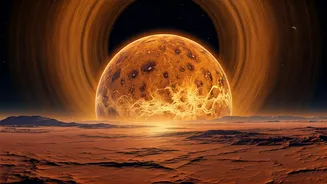


The Fact That Breaks Your Brain
Let’s get it out of the way, because it’s a genuine cosmic riddle. A single day on Venus lasts longer than its entire year. It’s the kind of fact that sounds like a mistake, a typo in an astronomy textbook. But it’s entirely true, and it makes Venus one
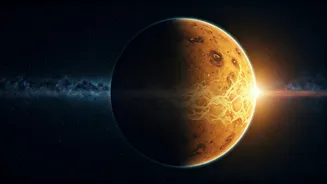
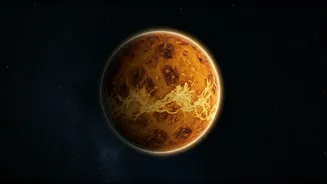
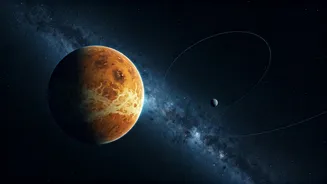
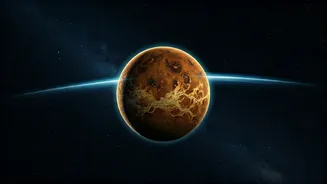
of the most peculiar places in our solar system. While Earth zips through a day in 24 hours and a year in 365 days, Venus operates on a completely different, much lazier schedule. This single fact, often shared alongside hauntingly beautiful images of Venus’s thick clouds, is a gateway to understanding just how weird and wonderful our planetary neighbours can be.
Putting Numbers to the Weirdness
To wrap your head around this, you need two key numbers. First, how long it takes Venus to orbit the Sun (its year). Second, how long it takes to spin once on its axis (its day).
- A Venusian Year: Venus is closer to the Sun than Earth, so it has a shorter path to travel. It completes one full orbit in about 225 Earth days. So, if you were born on Venus, you’d celebrate your birthday every 225 Earth days.
- A Venusian Day: Here’s where it gets strange. Venus is an incredibly slow spinner. It takes approximately 243 Earth days for it to complete just one rotation on its axis.
So there you have it: the planet takes 243 Earth days to spin once, but only 225 Earth days to go around the sun. A day is nearly 20 Earth days longer than a year. Imagine your birthday arriving before the sun has even set for the 'day' you were born.
The Secret: It Spins Backwards
The slow rotation is only half the story. The other crucial element is that Venus has what’s known as retrograde rotation. This means it spins on its axis in the opposite direction to most other planets in the solar system, including Earth. If you could stand on the surface of Venus (and survive its crushing pressure and scorching 465°C heat), you would see the Sun rise in the west and set in the east. Only Venus and Uranus have this bizarre backward spin. This retrograde motion is a critical piece of the puzzle, because it messes with how we define a 'day'.
Sidereal Day vs. Solar Day
This is where most of us get tripped up, because there are two ways to measure a day. A *sidereal day* is the time it takes for a planet to complete one full 360-degree rotation on its axis. For Venus, this is the 243 Earth-day figure. However, a *solar day* is the time it takes for the Sun to return to the same position in the sky (e.g., from one noon to the next). Because Venus is moving in its orbit *while* it's slowly spinning backwards, these two measurements are wildly different.
On Earth, they are very similar: a sidereal day is 23 hours and 56 minutes, and a solar day is 24 hours. But on Venus, the slow backward spin works against its orbit, causing the sun to appear to move across the sky much faster than the planet's actual rotation speed would suggest. The result? A solar day on Venus—the time from one sunrise to the next—is 'only' about 117 Earth days. It’s still incredibly long, but it’s much shorter than the planet's 243-day rotation period. So, you get about two sunrises and sunsets for every sidereal day, and also for every year.
Why Is Venus So Strange?
Scientists don't have a definitive answer, but they have some compelling theories. The leading idea is that early in its history, Venus was struck by a massive planet-sized object that knocked it off-kilter, reversing its spin or slowing it down to a near standstill, from which it started spinning backwards. Another powerful theory involves Venus’s incredibly thick and heavy atmosphere—90 times denser than Earth’s. Scientists suggest that powerful atmospheric tides, created by solar heating, could have exerted a drag on the planet over billions of years, slowing its rotation and eventually reversing it. It's possible a combination of an ancient impact and atmospheric friction created the bizarre planetary clock we see today.